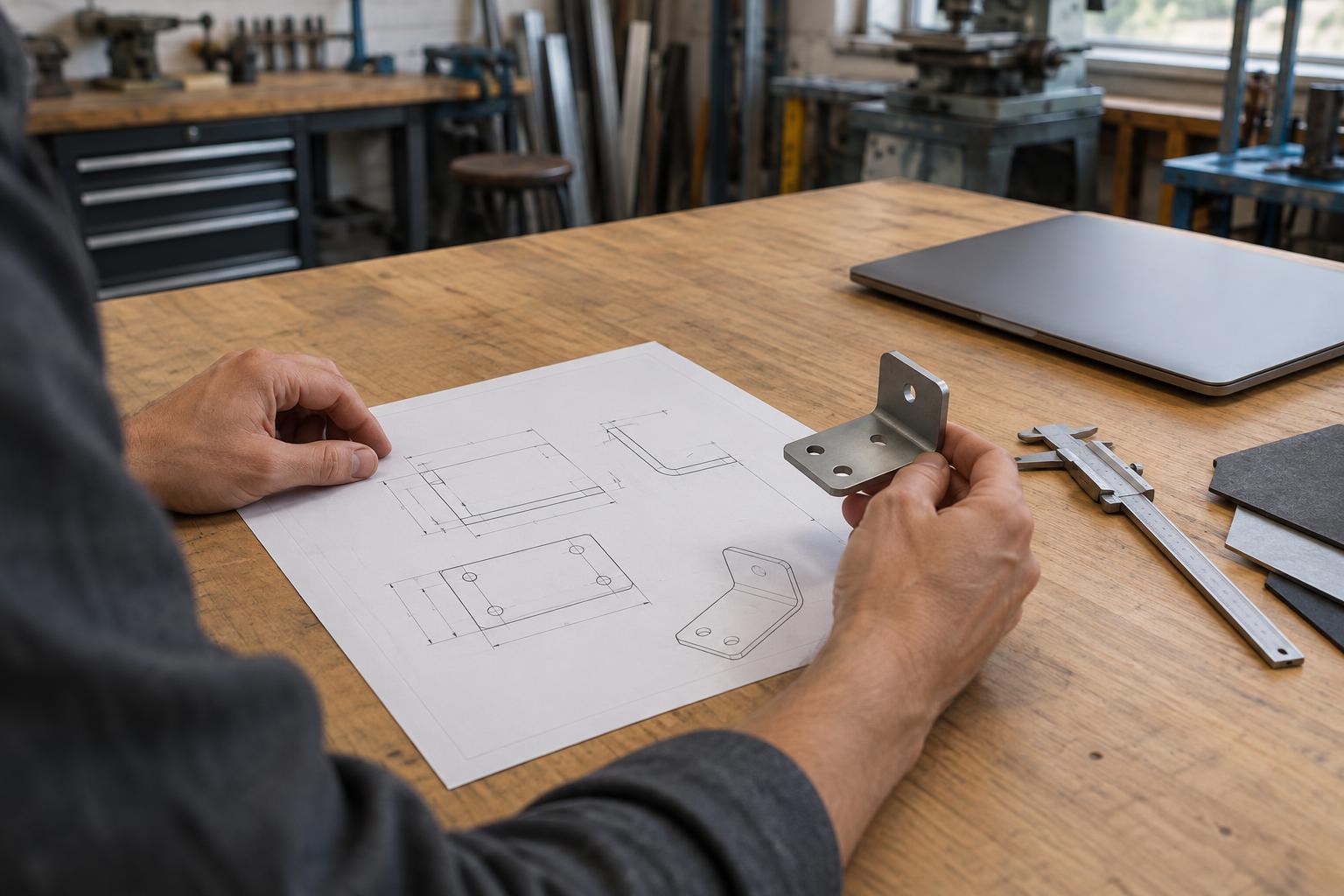
Start with what the design must do
Design failure mode and effects analysis, or design FMEA, is a structured way to examine how a product might fail to meet its intended functions. It is most useful while the design can still change. The aim is not to predict every possible defect or fill a spreadsheet with alarming scenarios. It is to make important assumptions visible, decide which risks deserve attention, and record how the team addressed them.
Begin by setting a boundary: which product, assembly, or component are you reviewing, and under what expected conditions will it be used? List its functions in specific terms. A cabinet hinge, for example, must carry the door, allow repeated movement, maintain alignment, and remain securely attached. Its appearance may also be a function if a visible gap or finish is part of the design intent. Clear functions give the team something concrete to test each potential failure against.
Separate failure modes, effects, and causes
For each function, ask: how could the design fail to perform it? That answer is the failure mode. A hinge might loosen, bind, or permit the door to sag. Next, describe the effect from the perspective of the assembly and the user: a sagging door may rub the frame, become difficult to close, or look misaligned. Then ask what design-related conditions could cause that mode, such as insufficient support around a fastener, an unsuitable material pairing, or too little clearance for expected movement.
Keeping these columns distinct makes the analysis more useful. “Poor design” is too vague to be a cause, while “door does not close” may be an effect rather than the underlying failure mode. Include interfaces, not just individual parts: a sound hinge design can still perform poorly if its mounting pattern leaves inadequate material at the edge of a panel. Record what is known, and label assumptions that need a test or calculation.
Assess risk without treating scores as facts
Many teams rate severity, occurrence, and detection to help prioritize work. Severity describes the consequence if a failure happens. Occurrence expresses how plausible the cause seems under the defined conditions. Detection asks how likely existing design checks are to find the problem before release. Agree on what each rating means before scoring; otherwise, one person’s “high” may be another person’s “moderate.” These ratings are judgments supported by available evidence, not measured probabilities.
A numerical priority score can help sort a long list, but it should not make decisions by itself. A severe potential effect merits discussion even if the team believes it is unlikely. Likewise, a modest inconvenience that could arise often may justify a simple design change. Note the reasoning behind each rating, especially where experience is limited. That makes the analysis easier to revisit when a prototype, material choice, or intended use changes.
Turn concerns into design actions
A useful FMEA leads to actions that address causes or improve the ability to find failures. For the hinge example, the team might increase mounting support, change a fastener location, specify a more suitable mating material, or revise the clearance. A prototype cycling test might reveal loosening, but the test alone does not remove the cause. Record both the design change and the check that will show whether it works.
Give each action an owner, a clear outcome, and a point at which it must be reviewed. After the change, revisit the failure mode and its ratings rather than assuming the risk has disappeared. A new feature can create a new interface or trade-off: a thicker reinforcement plate, for instance, might improve support while reducing installation clearance. Design FMEA is therefore iterative, not a document to complete once and file away.
Keep the review small enough to be useful
For a first design FMEA, choose a manageable assembly and bring together people who see different parts of its life: design, prototyping, production, installation, or service, as relevant. A drawing reviewer may notice tight clearances; someone who assembles the product may spot a fastening assumption. Their observations help the team ask better questions, even when firm evidence is not yet available.
Keep design risks separate from failures caused chiefly by the manufacturing process. A design that provides too little clearance belongs in design FMEA; an otherwise suitable hole drilled in the wrong position is primarily a process issue. The two reviews can inform each other. Before release, check that significant actions have been completed, evidence is linked to the decisions it supports, and unresolved risks have been explicitly considered. The value lies in those decisions—not in the number of rows filled.