Start with the job, not the magnet grade
A magnet might hold a cabinet door closed, locate a removable panel, turn a sensor on and off, or couple two parts without a visible fastener. These jobs impose different requirements. A closure needs a comfortable pull-off force; a positioning feature needs repeatable alignment; a sensor may need a predictable magnetic field at a particular distance. Before selecting a material, define the gap between parts, the available space, the direction of the load, and how often the assembly will be opened.
Ferrite and neodymium are common permanent-magnet materials, but neither is universally better. Neodymium magnets can provide a stronger magnetic effect in a smaller space. Ferrite magnets generally offer lower magnetic performance for a given size but can be a practical choice when there is room for a larger part. The useful question is not which magnet is strongest. It is which assembly reliably performs its task without creating avoidable cost, fragility, or difficulty during production.
Account for size, gap, and load direction
Published pull-force figures can be tempting shortcuts, yet a magnet's behavior changes when it leaves the test arrangement. A coating, decorative cover, uneven surface, or layer of adhesive creates an air gap that can noticeably reduce attraction. The material and thickness of the mating steel part matter too. A magnet that feels powerful against a thick steel plate may behave differently against thin sheet metal or another magnet.
Load direction deserves equal attention. A magnet holding a lid shut resists separation differently from one preventing a panel from sliding sideways. If sliding is the concern, the friction of the contacting surfaces and any locating features become important. A small lip, pin, or recess can take the sideways load while the magnet keeps the parts seated. That arrangement may allow a less powerful magnet and make the product easier to open deliberately.
Prototype the magnet in the intended housing with the intended mating part rather than testing a loose magnet on a workbench. Include the actual finishes, gaps, and expected variations in assembly. Check both the weakest acceptable hold and the strongest acceptable opening force: an excessively strong closure can be just as inconvenient as a weak one.
Consider exposure, heat, and breakage
Ferrite is a ceramic material and is generally resistant to corrosion, but it is brittle and can chip under impact. Neodymium magnets are also brittle and commonly rely on a protective coating because the underlying material can corrode when exposed. A damaged coating, wet crevice, or abrasive mating surface can therefore change the service life of an otherwise suitable neodymium part. Neither type should be treated as a tough structural stop.
Temperature limits cannot be inferred from the material name alone. Magnetic performance can change with temperature, and excessive heat may cause lasting loss of magnetization. Different grades and constructions have different limits. If a magnet will sit near a motor, heater, sun-warmed enclosure, or hot cleaning process, check the supplier's limits for the exact part and test the assembled product under its expected conditions.
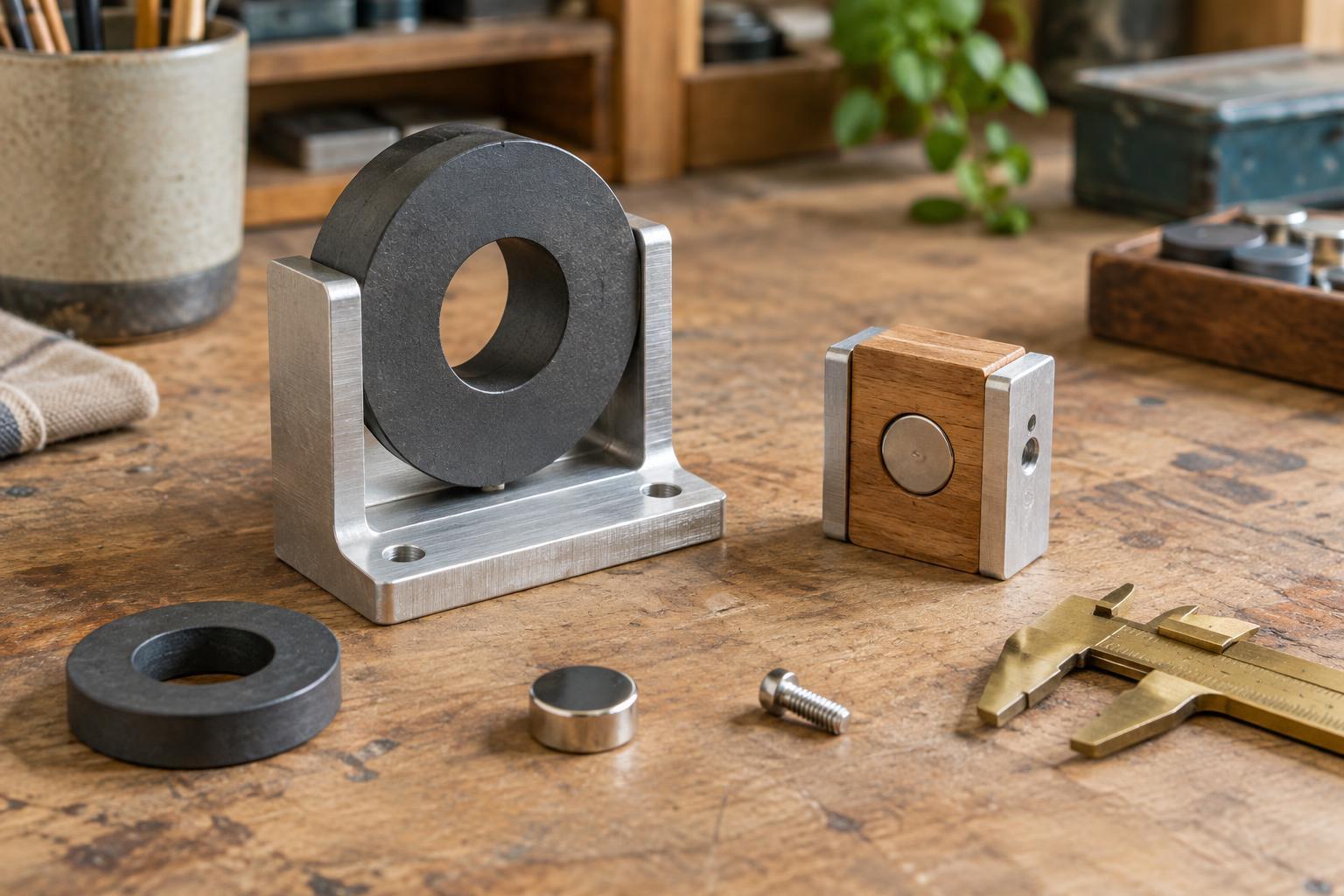
Shape and mounting method also affect durability. A thin magnet bonded only at one edge is more vulnerable to shock than one supported by a pocket. A close-fitting recess can protect edges and help locate the part during assembly, provided it leaves appropriate space for adhesive or other retention. Where a magnet might come loose, consider how the design will retain it throughout use, especially in products accessible to children.
Design the whole assembly for production and repair
A drawing should specify more than diameter and thickness. Record the magnetic orientation, required face, permitted dimensional variation, coating or finish where relevant, and how the magnet is retained. Polarity mistakes can make a finished assembly repel instead of attract. Simple assembly aids, such as a marked reference face and a check against a known mating part, can catch errors before a magnet is permanently bonded in place.
Think ahead to replacement and disassembly. An accessible mechanical retainer may make a worn or damaged part easier to service than a deeply buried bonded magnet. If bonding is necessary, the adhesive must be suitable for the magnet's surface and the expected environment. Separating magnets from surrounding materials at end of life may also be easier when the assembly can be opened without destroying it.
Choose ferrite when its larger size is acceptable and its properties suit the environment and budget. Choose neodymium when compactness or a stronger field is important and the design can protect the magnet appropriately. In either case, judge the complete assembly rather than the magnet alone: the gap, mating material, retention method, and user experience determine whether the choice works.