Start with the housing’s job
A product housing does more than cover internal parts. It may protect components, locate fasteners, hold a seal, survive a drop and provide the surface a person sees and touches. ABS, polypropylene (PP) and polycarbonate (PC) can each meet some of those needs, but none is the best choice for every enclosure.
Before comparing materials, describe how the housing will be used. Will it sit indoors or spend time in sunlight? Might it be cleaned with chemicals? Does it need to feel rigid, bend repeatedly or let light through? The answers matter more than a broad label such as “strong plastic.” Part thickness, rib placement, molding conditions and the selected material grade also affect the finished housing.
ABS: a practical choice for rigid, finished surfaces
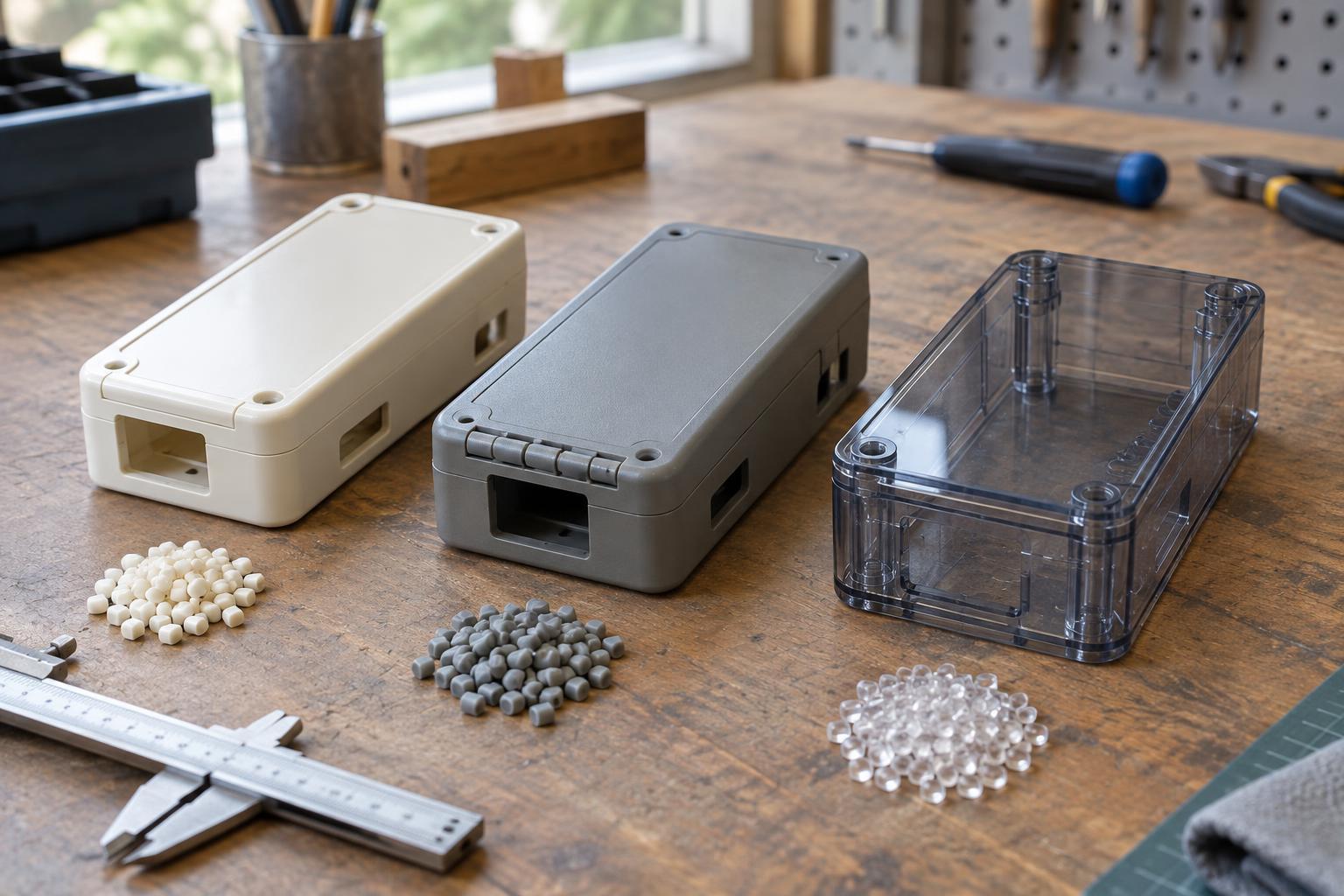
ABS is often considered when a housing needs a firm feel, crisp features and a consistent cosmetic surface. It can accommodate bosses, ribs and mating edges, making it useful for multi-part enclosures that are screwed or snapped together. It is also available in grades and colors suited to visible parts, and its surface is generally more receptive to painting or other finishes than untreated PP.
Its limits deserve attention. Standard ABS may lose appearance or performance after prolonged outdoor exposure unless an appropriate grade or protective finish is chosen. Solvents and aggressive cleaners can also damage it. Although ABS can withstand everyday knocks, a housing expected to face severe impacts or particular temperature demands may call for another material or a different grade. A clean-looking ABS sample is therefore a starting point, not proof that the design will survive its intended use.
Polypropylene: light, flexible and chemically tolerant
PP is useful when low weight, flexibility or resistance to many common chemicals is a priority. Its ability to flex repeatedly makes it a strong candidate for an integral living hinge, such as a lid joined to its base by a thin molded section. That feature must still be designed and tested carefully; simply making a wall thin does not guarantee a durable hinge.
The same flexibility can be a drawback when a housing needs a rigid, precise feel. PP also tends to shrink more during cooling than ABS or PC, so uneven wall thickness and poorly placed ribs can contribute to distortion. Paints, adhesives and printing may require surface preparation or processes suited to PP’s low surface energy. Where appearance matters, it is worth making representative molded samples rather than judging the material from a flat plaque.
Polycarbonate: impact resistance with design trade-offs
PC is a candidate for housings that need high impact resistance or transparent features. Depending on the grade, it can also serve where higher operating temperatures are expected than standard ABS or PP would comfortably handle. A clear window or a tough protective cover may therefore point a designer toward PC, though an entire opaque housing does not necessarily need the same material as its window.
PC brings its own constraints. It can scratch, and contact with certain chemicals can cause stress cracking, particularly around loaded features such as tight fasteners. The resin normally needs appropriate drying before molding, and processing must be controlled to achieve sound parts. It may also cost more than the alternatives. If transparency is not required, compare the actual benefit of PC against a revised design in ABS or PP rather than assuming the toughest-sounding material is the safest choice.
Choose by testing the part, not just the resin
A useful first comparison groups requirements into four questions: How rigid should the housing feel? What impacts and temperatures might it encounter? Which substances will touch it? What must its visible surface look like? ABS often suits a rigid, finished indoor enclosure; PP may suit a light housing with flexible features or chemical exposure; PC may suit a highly impact-resistant cover or a transparent component. These are starting points, not guarantees.
Next, examine the design features most likely to fail: screw bosses, snap fits, hinges, corners, seams and thin areas around openings. Make samples using the intended wall thickness and assembly method, then check fit, handling, cleaning and foreseeable drops. If a flame-rated, outdoor-stable or food-contact grade is needed, specify and verify that requirement separately; a polymer name alone does not establish compliance.
Material choice also affects resource use. A durable housing that can be repaired or opened may be more useful than one optimized only for minimum weight. Avoiding unnecessary coatings and combining materials only where they provide a clear benefit can simplify production and later sorting. The strongest decision is one that balances service life, workable manufacturing and the actual demands placed on the product.