Why ceramics behave differently from metals
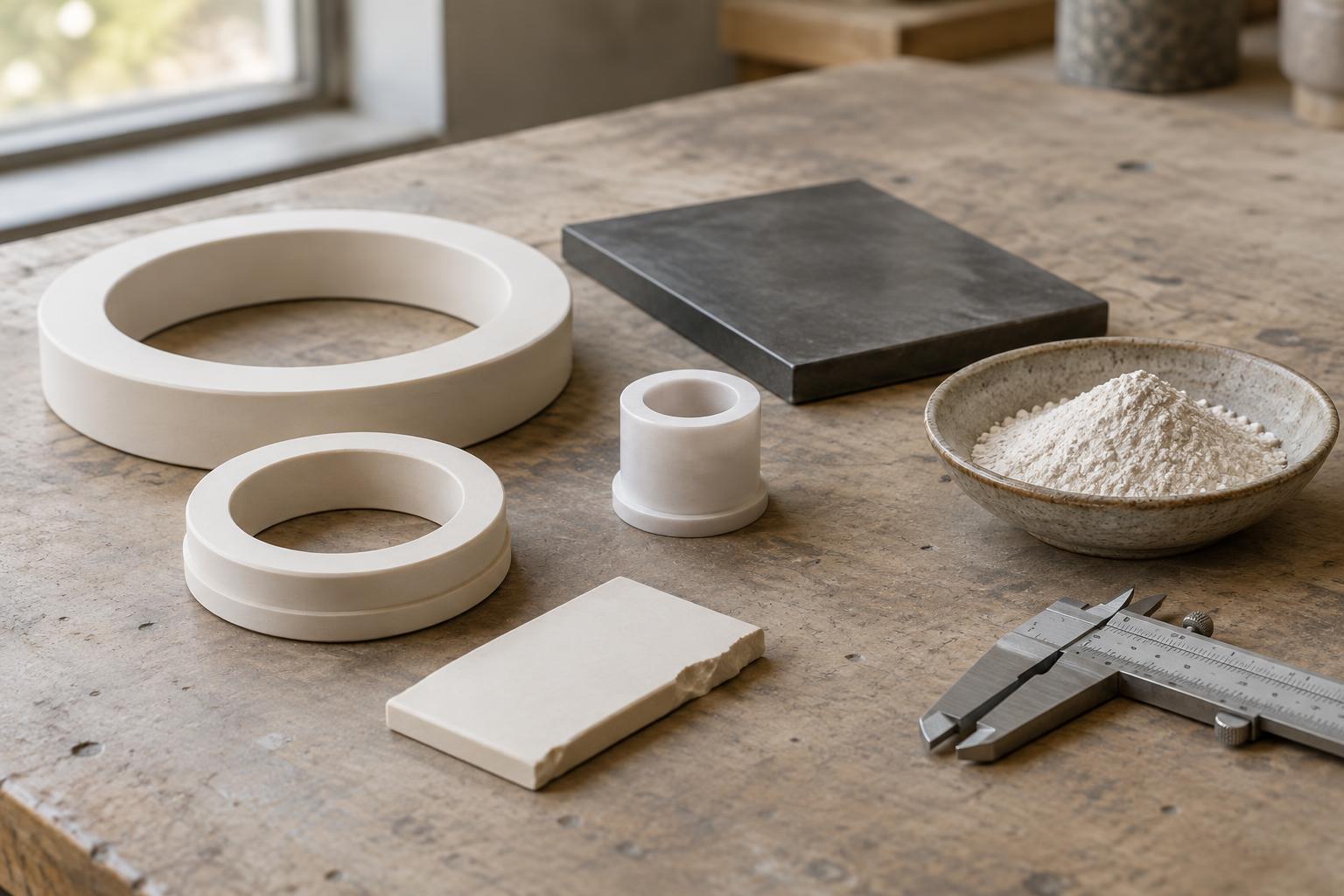
Technical ceramics are engineered, nonmetallic materials used where properties such as hardness, wear resistance, electrical insulation, or stability at elevated temperatures matter. Familiar examples include alumina, zirconia, silicon carbide, and silicon nitride. They are not interchangeable: each has a different combination of strength, thermal behavior, cost, and processing requirements.
The central trade-off is that a surface can be hard without being forgiving. A hard ceramic may resist scratching and abrasion while remaining vulnerable to cracks that begin at an edge, a pore, or a machining mark. Metals often deform visibly before they break; many ceramics show little such warning. That difference affects not just material choice but the shape of a part, the way it is mounted, and how it is handled on the workshop floor.
Hardness is only one measure of durability
Hardness describes resistance to localized indentation or scratching. It helps explain why ceramics can work well in wear surfaces, guides, and components exposed to abrasive particles. Yet hardness alone does not predict whether a part will survive a dropped tool, a clamped joint, or repeated bending. Fracture toughness—resistance to the growth of an existing crack—is a separate property and often the more important one when impact or uneven loading is possible.
Geometry can either protect or undermine a ceramic. Rounded transitions reduce stress concentrations; sharp internal corners, thin unsupported walls, and small contact points can encourage cracking. A design that spreads a load across a broad, well-aligned surface is generally safer than one that presses on an edge. The mating parts matter too: an assembly that restrains a ceramic too tightly may create damaging stress as its components expand by different amounts.
Heat resistance does not guarantee thermal-shock resistance
Many technical ceramics retain useful properties at temperatures that would challenge common polymers or some metals. But surviving a high steady temperature is different from surviving a rapid temperature change. If one part of a component heats or cools faster than another, uneven expansion can produce internal stress and start a crack.
Thermal-shock behavior depends on several properties working together, including thermal expansion, thermal conductivity, strength, and fracture toughness. Part size and shape also affect how quickly temperature gradients develop. A ceramic liner in a steadily heated environment may face a different challenge from a thin part repeatedly moved between hot and cold conditions. When comparing candidate materials, the expected heating and cooling cycle deserves as much attention as the maximum operating temperature.
From powder to finished component
Most technical ceramic parts begin as carefully prepared powders. A manufacturer forms the powder into a shape and then fires it at high temperature to bond and densify the material. Because the part shrinks during firing, achieving a final dimension requires control over the starting shape and the process. Complex features and tight tolerances may require finishing after firing, when the material is hard and more difficult to machine.
These production steps make early design decisions consequential. A hole, groove, or slender projection that looks simple in a drawing may be difficult to form consistently or finish without damage. Specifying a polished surface or very tight tolerance everywhere can add work without improving the part’s function. It is more useful to identify which faces locate the component, which surfaces experience wear, and where a less exact finish is acceptable.
Choosing a ceramic for the actual job
A useful selection process starts with the likely failure mode. For abrasive wear, surface hardness and the nature of the contacting material may take priority. For a part exposed to impact or fluctuating loads, toughness and protective geometry deserve closer attention. For a heated assembly, consider both steady operating conditions and temperature changes during startup, shutdown, and cleaning. Alumina is a common starting point for wear resistance and insulation; zirconia may be considered where greater toughness is valuable. Silicon carbide and silicon nitride can suit certain demanding heat or wear applications, but the right grade and processing route still depend on the job.
Finally, consider the whole component rather than the ceramic in isolation. Supports, fasteners, seals, and handling practices can determine whether a sound material performs reliably. Avoiding unnecessary precision, protecting vulnerable edges, and planning for replacement can also reduce wasted material and finishing effort. Technical ceramics reward this kind of joined-up thinking: their strengths are considerable, provided the design makes room for their limitations.