Why heating and cooling change steel
Steel’s properties depend not only on its composition but also on its microstructure: the arrangement of its phases and grains. Heating can change that arrangement, while the cooling path determines which structures form afterward. This is why two pieces made from the same grade of steel can behave differently after different heat treatments.
Annealing, quenching, and tempering are not three interchangeable ways to make steel “better.” Each serves a different purpose. Annealing commonly makes steel softer and easier to work. Quenching can produce a hard structure, but may also leave the part brittle or distorted. Tempering usually follows hardening to adjust the balance between hardness and toughness. The useful result depends on the steel grade, the part’s dimensions, and what the finished part must do.
Annealing: making steel easier to work
Annealing is a family of treatments rather than one fixed heating schedule. In a common form, steel is heated to a temperature suited to its grade and intended result, held long enough for the needed changes, then cooled in a controlled way, often slowly. Depending on the treatment, annealing can soften steel, improve machinability, reduce the effects of prior forming, or prepare its structure for a later operation.
For a workshop, the benefit may appear at the next station. A softer blank can be easier to cut, drill, or form, with less tool wear or risk of cracking. Annealing can also help make a batch more consistent when pieces arrive with different processing histories. It does not, however, guarantee that every type of stress or variation has been removed.
The word matters because a drawing or job sheet that says only “anneal” may not identify the desired outcome. Full annealing, process annealing, and spheroidizing, for example, target different starting conditions and properties. A useful process specification names the steel grade, the required result, and the heating and cooling procedure rather than relying on the label alone.
Quenching: gaining hardness through rapid cooling
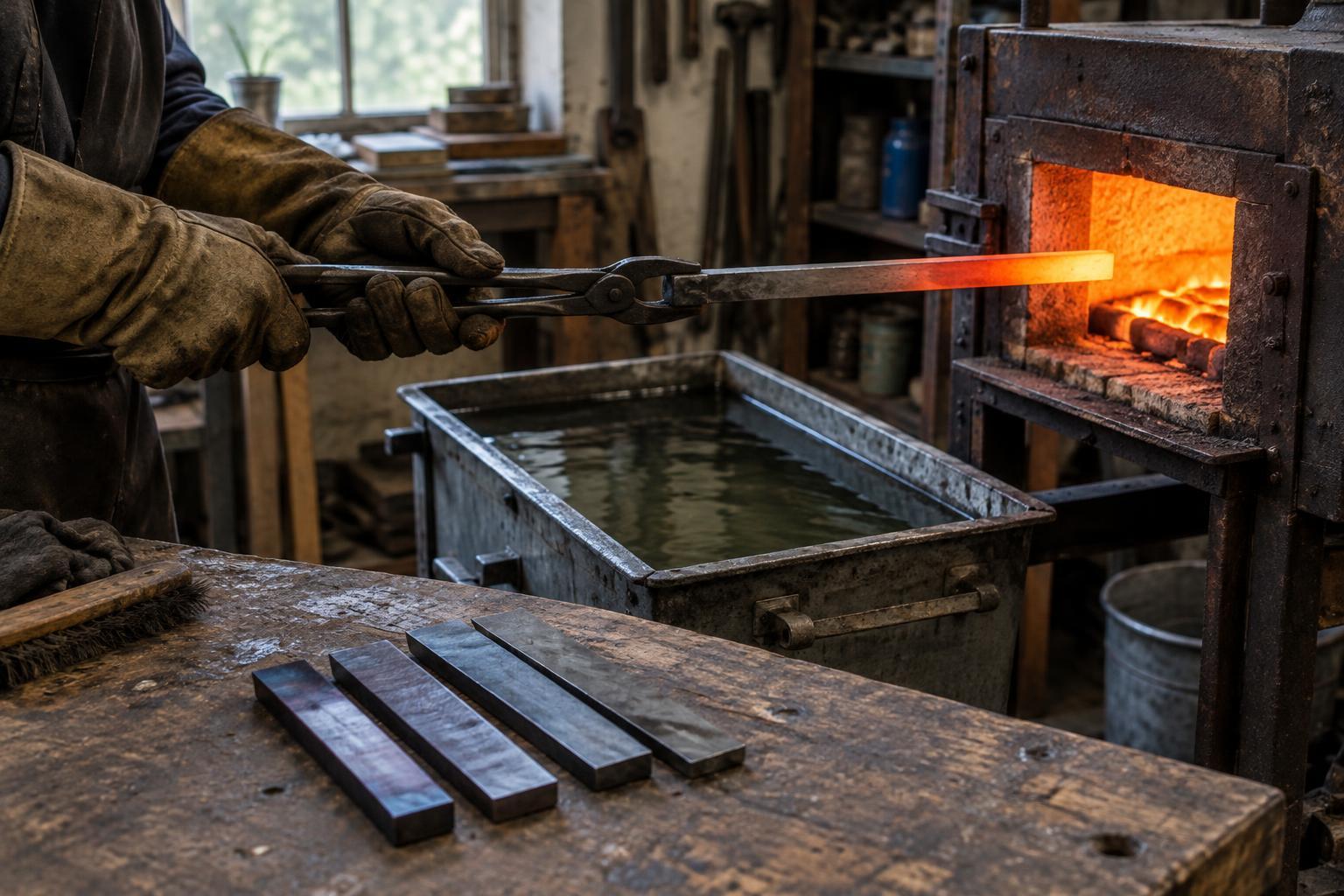
Hardening by quenching generally begins by heating suitable steel until its structure becomes austenite. The part is then cooled rapidly enough to form martensite, a hard structure that resists wear and deformation. The required heating conditions and cooling rate vary with the steel. Not every steel can reach the same hardness, and a thick section may cool differently at its surface and center.
The quench medium helps set the cooling rate. Oil, water, air, and other methods are selected for particular steels and part geometries; the fastest available cooling is not automatically the best choice. Cooling too aggressively can increase distortion or cracking, while cooling too slowly may fail to produce the intended hardness. Sharp corners, uneven section thickness, and how a part is supported or moved during quenching can also affect the result.
A quenched part may be very hard but too brittle for service. Quenching is therefore often an intermediate step, not the end of the process. It also demands appropriate equipment and controls: hot steel and quench media present burn, fire, and handling hazards.
Tempering: adjusting a hardened structure
Tempering usually follows quenching. The hardened steel is reheated to a temperature below the range used to form austenite, held, and then cooled. During this treatment, the as-quenched structure changes. In general, tempering reduces brittleness and internal stresses while sacrificing some hardness. The aim is not simply to make the steel softer; it is to obtain properties suited to the part’s job.
The chosen tempering conditions influence the trade-off. A cutting edge may call for a different balance than a spring or a loaded shaft. Steel composition matters as well: alloy steels do not all respond to tempering in the same way. Because a hard part can look unchanged after tempering, appearance alone is a poor way to judge whether the intended properties were achieved.
Tempering cannot reliably repair every problem introduced earlier. A cracked part remains cracked, and an incorrect quench may leave too little hardened structure to meet a specification. Treating each stage as part of one planned sequence is more dependable than trying to correct an unsuitable result at the end.
Planning and checking the sequence
Start with the function of the finished part: where does it need wear resistance, toughness, dimensional accuracy, or ease of machining? From there, choose a steel grade and a process route together. A blank might be annealed before machining, then hardened by quenching and tempered after machining. Another part may need only a softening treatment. There is no universal sequence for every component.
Good workshop records connect the part to its steel grade, furnace cycle, cooling method, and inspection results. Hardness checks can indicate whether a treatment reached a target, while dimensional checks reveal movement that may affect fit. For demanding parts, additional examination may be needed to confirm the structure or identify cracking. These checks make heat treatment a controlled production method rather than a final step judged by color or appearance.