How the two supports work
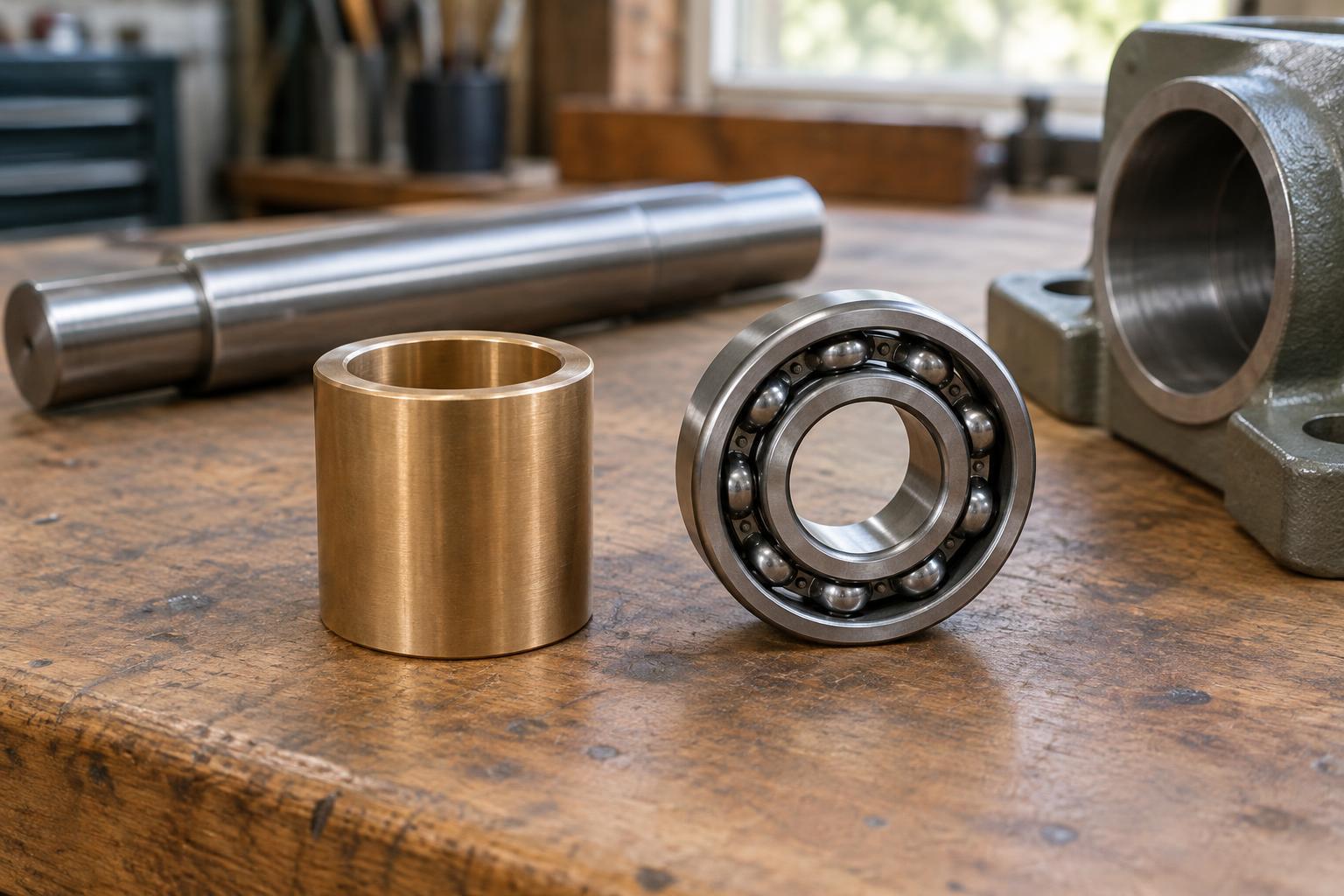
A rotating shaft needs support that holds it in position while allowing it to turn. A bushing is a sleeve or shaped surface on which the shaft slides. It may be made from bronze, polymer, or another bearing material chosen for the shaft, operating conditions, and available lubrication. A ball bearing places rolling balls between inner and outer rings, so most of the relative motion occurs through rolling rather than sliding.
Neither design is automatically better. A bushing can be compact, straightforward to install, and well suited to slow or intermittent movement. A ball bearing can provide low running friction and precise support for continuous rotation. The useful comparison is not simply the price of each component, but how the complete assembly behaves throughout its intended use.
Start with the motion and the load
First describe what the part actually does. Does it spin continuously, turn a few revolutions at a time, or only pivot through a limited angle? How fast does it move, and how often does it start under load? Bushings are often worth considering for slow, oscillating, or shock-prone joints. Ball bearings are commonly useful where a shaft must rotate freely for extended periods, particularly when low friction matters.
Load direction matters as much as load size. Radial load acts across the shaft; axial load pushes along it. Some bushings primarily support radial load and need a separate thrust surface to handle axial force. Ball bearings also vary: a bearing selected for radial duty should not be assumed to tolerate every axial load. If a shaft carries both types of force, identify the load path before choosing a part.
Consider lubrication, dirt, and temperature
Sliding surfaces depend on a suitable pairing of materials and, in many designs, an appropriate lubricant. Some bushings are made to run with little added lubrication under specified conditions, while others rely on an oil or grease supply. A loss of lubrication can increase wear or cause the shaft to seize. Ball bearings usually arrive with a defined lubrication approach too, and their rolling surfaces can be damaged by contamination or inadequate lubricant.
Think about the environment around the support. Dust, washdown, moisture, and heat can change what works well. Seals or shields may protect a ball bearing, but they add design considerations and are not a substitute for keeping severe contamination out of the assembly. A bushing may be easier to clean or replace in some equipment, yet abrasive particles trapped between its sliding surfaces can accelerate wear. Material and lubricant compatibility should be checked for the actual operating conditions.
Design the housing and shaft together
A good support choice can still fail if the surrounding parts are poorly prepared. Bushings need an appropriate shaft surface, running clearance, and secure fit in the housing. Too little clearance can cause binding as parts expand or the housing distorts; too much can produce wobble and uneven wear. Shaft hardness and finish may also affect how a bushing performs.
Ball bearings need correctly sized seats and a mounting arrangement that does not squeeze, loosen, or misalign the rings. Decide which ring rotates relative to the load, how the bearing will be retained, and how axial movement will be controlled. Either option may require attention to alignment when two supports carry the same shaft. Component dimensions and tolerances should be taken from the selected part’s specifications rather than guessed from a nominal shaft diameter.
Choose for the whole service life
For an early comparison, make a short list of requirements: motion, radial and axial loads, speed, duty cycle, space, temperature, exposure to dirt or water, acceptable play, and expected maintenance. Then compare candidate supports on those same terms. A bushing may save space and simplify replacement but need closer attention to wear and lubrication. A ball bearing may reduce running friction but require more careful seating and protection.
Finally, consider how the product will be assembled and serviced. Can a worn support be removed without damaging the housing? Can lubricant reach it, and can a technician tell when it needs attention? If the choice is uncertain, test representative parts in the intended housing under realistic loads and conditions. That small assembly trial can reveal heat, noise, looseness, or wear that a component-by-component comparison misses.