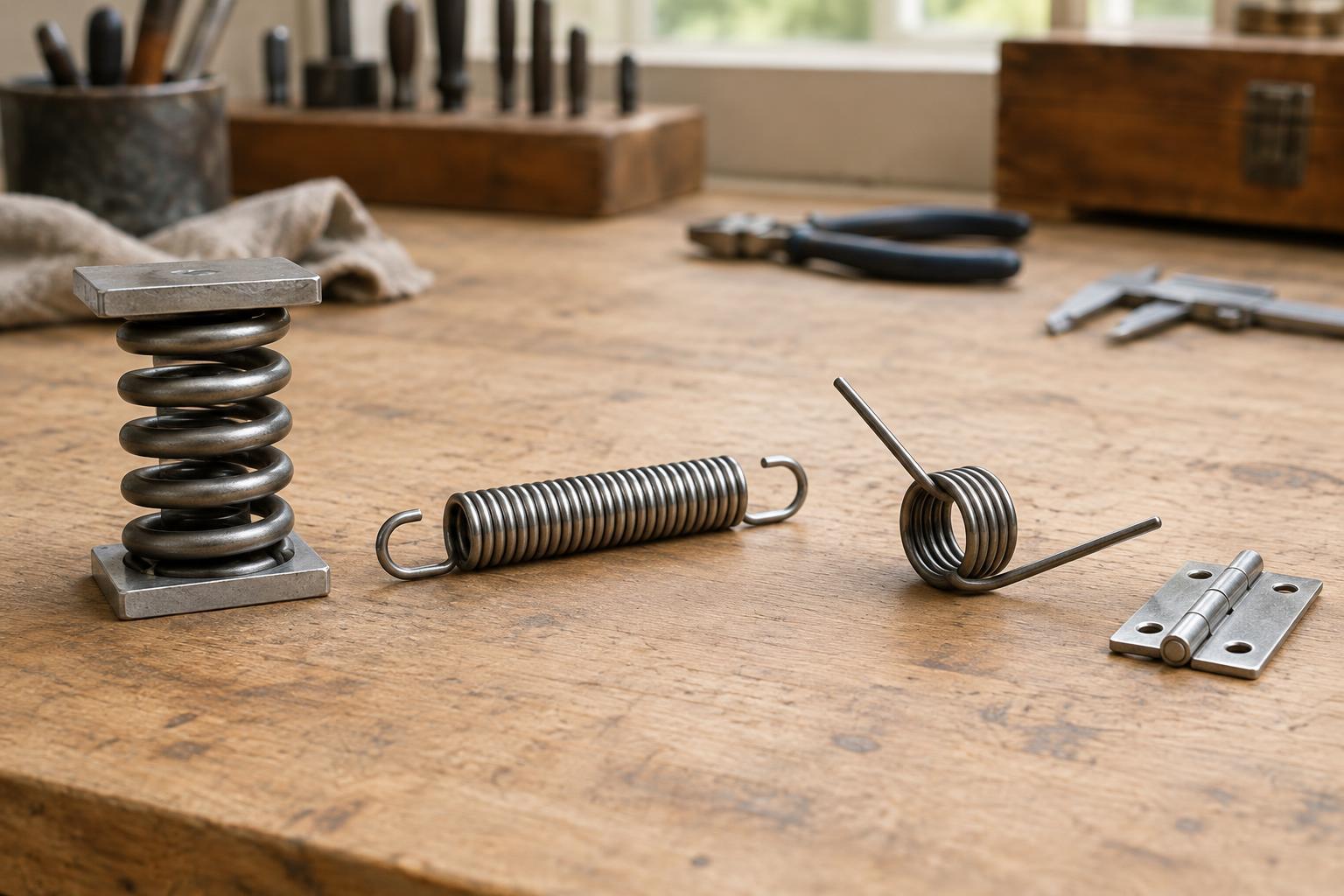
Three springs, three kinds of movement
A spring stores energy as it changes shape and releases that energy when it returns toward its original position. The first question in choosing a spring is not what it looks like, but how the surrounding parts move. Does a mechanism push two surfaces together, pull them apart, or rotate one part relative to another? Those motions point toward compression, extension, and torsion springs respectively.
All three can be made from coiled wire, which makes them easy to confuse at a glance. Their ends, mounting arrangements, and working loads differ, however. A suitable spring must provide the needed force or torque throughout its working movement, fit the available space, and tolerate the expected number of cycles. Its behavior also depends on details such as wire diameter, coil dimensions, material, and how far it is deflected.
Compression springs resist being squeezed
A compression spring becomes shorter when an axial load presses on its ends. As it compresses, it pushes back. Release the load and, within its intended working range, it expands again. Compression springs are common beneath buttons, inside valves, and between parts that need to be held apart or returned after a push.
The spring needs enough room to operate without being crushed beyond its intended limit. At solid height, its coils have closed together and it cannot compress much further; a mechanism that continues to move may damage the spring or nearby parts. A long, narrow compression spring can also bow sideways under load. A guide rod, surrounding bore, or change in spring proportions may help keep it aligned. The surfaces supporting its ends matter too: uneven seating can introduce sideways forces where a straight push was intended.
Extension springs resist being pulled apart
An extension spring lengthens when its ends are pulled away from each other, then draws the connected parts back together. It often has hooks, loops, or other end fittings for attachment. You might find one returning a lever, holding a cover closed, or maintaining tension in a simple linkage.
Many extension springs have coils that touch when unloaded. They may require a certain initial pull before those coils begin to separate, a characteristic known as initial tension. This can be useful when a mechanism must remain taut rather than feel loose at rest. The end fittings deserve as much attention as the coil body: a hook can be a weak point if it is bent sharply, pulled at an angle, or repeatedly loaded. The design also needs a stop or sufficient clearance to prevent the spring from being stretched beyond its intended working length.
Torsion springs resist rotation
A torsion spring is commonly a coil with two projecting arms. When the arms rotate relative to each other, the spring applies a restoring torque. It can help a hinged lid return, bias a clip closed, or hold a movable part against a stop. Unlike a compression or extension spring, its useful output is described in terms of torque over an angle of rotation rather than force over a straight-line travel.
The arms must meet the mechanism at the intended angles and have secure bearing points. A spring that fits around a hinge pin may still perform poorly if its arms slip, interfere with nearby parts, or load the pin unevenly. Winding direction matters as well: the installed movement should load the spring in the direction intended by its design. Although it is called a torsion spring because it provides torque, the wire in a typical helical torsion spring is primarily stressed by bending.
Choose around the whole mechanism
To compare spring options, describe the motion first. Note the starting and ending positions, the available space, and the force or torque needed at each position. Then consider how the spring will be supported and attached. A well-sized coil cannot compensate for a hook that rubs against a sharp edge, a compression spring that buckles, or a torsion arm with no reliable contact point.
Working conditions also influence material and finish choices. Moisture, temperature, wear at contact points, and repeated cycling can affect service life. It is useful to check both the normal operating movement and any movement that might occur during assembly or misuse. If the mechanism can drive the spring farther than planned, a separate stop may protect it.
The simplest distinction remains a useful starting rule: compression springs push back when squeezed, extension springs pull back when stretched, and torsion springs turn back when rotated. Selection becomes more reliable when that rule is paired with a close look at travel, mounting, clearance, and the conditions in which the finished product will work.