Start with the joint, not the fastener
A fastener is only one part of a joint. The materials being joined, their thickness, the direction of the load and the way the product will be assembled all affect the choice. A fastener that works well in a rigid metal bracket may be unsuitable for a thin panel that bends around its hole. Before choosing a type, ask whether the joint must be opened for repair, whether workers can reach one or both sides, and whether the parts must be held tightly together or simply kept in position.
It also helps to separate two ideas: the load carried by the joint and the clamping force that holds its parts together. A tightened threaded fastener can clamp surfaces together, while a rivet is formed in place to retain the parts. Neither description alone tells you how a finished joint will behave. Hole fit, part shape and assembly quality matter just as much as the name on the fastener bin.
Screws: useful when a tool can reach the head
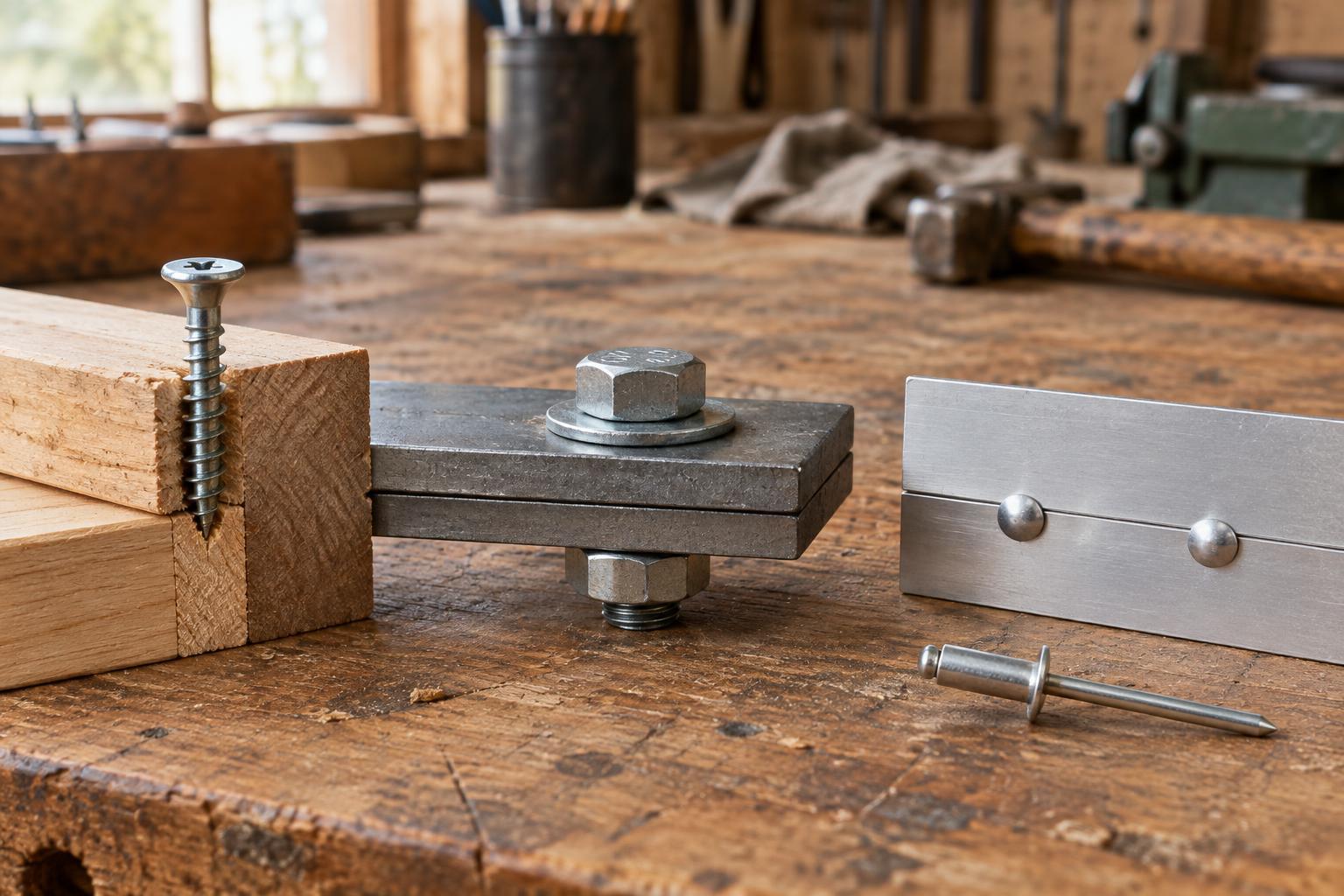
A screw is generally driven by turning its head into a mating thread. That thread might be cut into a metal part, provided by an insert, or formed as the screw enters a suitable material. Screws are often convenient when a nut would be awkward to hold or when assembly must happen from one accessible side. They are common in housings, fixtures and products designed to be opened.
The receiving material deserves close attention. A thread in a thin or soft part may wear or strip if it is tightened too hard or opened repeatedly. A threaded insert can make repeated assembly more practical, but it adds a component and an installation step. Head shape matters too: a countersunk head can sit flush, but its seat must suit the material and must not leave too little material around the hole.
A screw is not automatically removable forever. Damaged drive recesses, seized threads and adhesives can turn a routine repair into destructive work. If regular access is part of the product’s purpose, consider whether the chosen drive, thread and surrounding clearance will remain usable after years of handling.
Bolts: clamping parts with a mating thread
A bolt commonly passes through clearance holes and is tightened with a nut, though the everyday terms “bolt” and “screw” sometimes overlap. The practical distinction is the joint arrangement: a nut-and-bolt connection needs access to both ends during assembly, unless one side is captured or otherwise held. In return, it can join parts that have no suitable material for an internal thread, and a worn nut may be easier to replace than a damaged thread in a larger component.
Bolted joints are especially useful where controlled clamping and later disassembly are important. Their performance depends on suitable fastener size, thread engagement, bearing surfaces and tightening practice. Tightening too little can allow movement; tightening too much can damage threads or distort parts. Washers or larger bearing surfaces can help spread contact pressure in some assemblies, but they do not make a weak surrounding part strong.
Plan for the space a tool needs around the head and nut, not merely the space occupied by the fastener. A joint that looks accessible in a drawing may be slow to assemble once nearby walls, wiring or other components are installed.
Rivets: a joint intended to stay closed
A rivet is installed by deforming part of the fastener so that it retains the joined pieces. Solid rivets usually require access to both sides for installation. Blind rivets can be set from one side, making them useful for closed sections and panels where reaching the back is impractical. Riveting can suit repeatable assembly work because there is no nut to hold and no thread to engage.
The trade-off is serviceability. A conventional rivet is normally removed by drilling or another destructive operation, after which a replacement is needed. Hole quality and grip range matter: an oversized hole or a rivet unsuited to the total material thickness can produce a poor joint. Some blind rivets also leave a visible head on both sides or a retained stem, details that may matter for appearance, clearance or cleanliness.
Rivets are not a shortcut around joint design. A thin sheet can tear around a rivet, just as it can around a screw or bolt. Where parts flex in use, examine how movement is distributed rather than assuming that adding more fasteners will solve the problem.
Make a choice the workshop can repeat
For an early comparison, start with access and maintenance. If the product needs frequent opening, favor a serviceable threaded joint. If only the front face is reachable and the joint is expected to remain closed, a blind rivet may be worth considering. If parts need firm clamping and both sides are accessible, a nut-and-bolt arrangement may be straightforward. Then check the surrounding materials, hole locations, available tools and finished appearance.
Material compatibility is another practical filter. Fasteners and joined parts can respond differently to moisture and temperature; some dissimilar metal combinations may corrode in a damp environment. Protective finishes, isolation between materials and the product’s expected conditions should be considered together. Finally, make a sample joint using the intended parts and installation method. Checking how it fits, assembles, opens if required, and holds up in relevant use is more informative than choosing by fastener name alone.