Start with the job, not the label
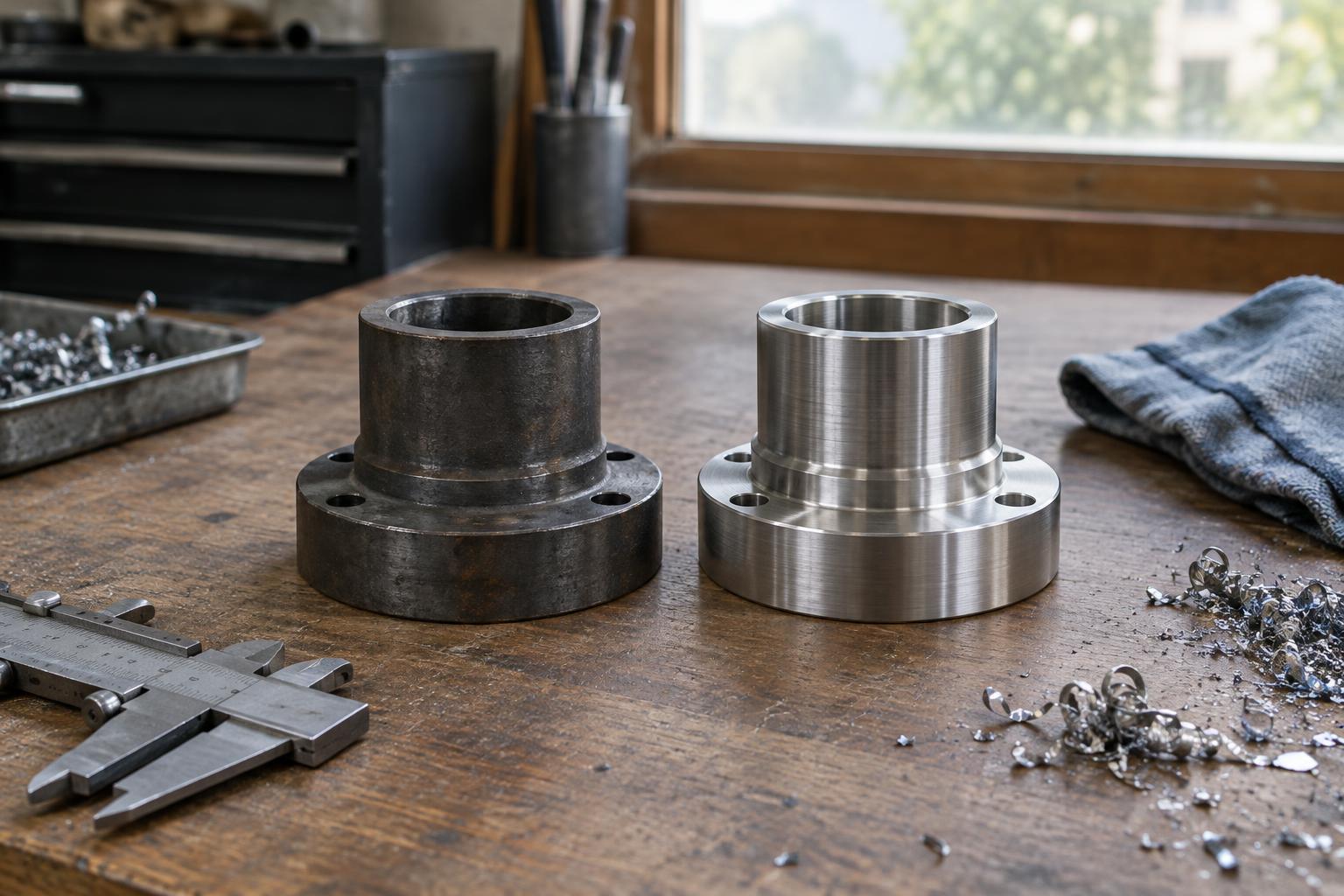
Carbon steel is primarily iron and carbon, while stainless steel contains enough chromium to form a thin, protective surface film. Both names cover many grades with different strength, hardness, forming behavior, and prices. Calling one “stronger” or “better” without naming a grade and condition rarely helps a material decision.
Begin with the part’s service conditions. Will it slide against another surface, carry an impact load, sit outdoors, or be cleaned with chemicals? Can it be painted, oiled, or replaced easily? A sheltered bracket and an exposed fastener may call for different steels even when they belong to the same assembly. Sketching these conditions first narrows the choices more effectively than comparing material prices alone.
Wear depends on the contact, not just hardness
Wear can mean abrasion from grit, damage from repeated impact, or galling when two surfaces slide under pressure. Hardness can help resist some abrasive wear, but it is not a universal measure of service life. A very hard part may be less forgiving of impact, while an unsuitable pair of sliding materials may seize despite appearing robust on paper.
Many carbon steels can be heat-treated or surface-hardened, making them useful for shafts, tools, and other parts with defined wear surfaces. Stainless grades also vary widely: some are chosen mainly for corrosion resistance and cannot be hardened by conventional heat treatment, while others can be hardened but may offer different corrosion performance. For sliding stainless components, galling deserves particular attention. Surface finish, lubrication, contact pressure, and the choice of mating material can matter as much as the base alloy.
Specify the wear mechanism before specifying a steel. If only one small surface takes the damage, a replaceable bushing, coating, or hardened insert may be more practical than making the entire component from a more expensive grade.
Corrosion resistance is conditional
Unprotected carbon steel readily rusts in damp conditions. Paint, plating, oil, or another protective finish can make it suitable for many uses, provided the finish can be applied consistently and inspected or renewed when needed. Edges, scratches, joints, and trapped moisture are common weak points in a coating-based approach.
Stainless steel’s chromium-rich surface film offers an advantage where routine coating maintenance is difficult. It is not immune to corrosion, however. Salt exposure, certain cleaning chemicals, crevices, and poor drainage can all cause trouble, depending on the grade and conditions. Fabrication also matters: contamination from carbon-steel tools or residue left around welds can compromise the surface. Good finishing and cleaning practices help the material deliver its intended benefit.
Think about the whole environment, including occasional cleaning and storage. A part that is dry in use but washed frequently may face a different corrosion challenge from one that is continuously exposed to humid air.
Compare the finished part’s cost
Carbon steel often has a lower initial material cost, but the finished-part comparison may include coating, handling, inspection, and future touch-ups. Stainless steel may reduce some of those tasks, yet its purchase price and fabrication costs can be higher. The balance changes with part size, quantity, finish requirements, and the workshop’s equipment and experience.
Consider waste as well as price per unit of stock. A design that uses a standard section efficiently may cost less and create fewer offcuts than one requiring extensive machining from a premium alloy. Conversely, a corrosion-resistant material may be worthwhile if it avoids frequent refinishing or early replacement. For repairable products, access to fasteners and wear parts can influence long-term cost more than a small difference in raw material price.
Do not assume a material substitution leaves the process unchanged. Cutting, drilling, welding, forming, and finishing choices may need adjustment. A small trial part can reveal difficult operations before a workshop commits to a larger batch.
Make the trade-off explicit
A practical selection note can fit on one page: name the intended service environment, the main wear mechanism, the required finish, the expected maintenance, and the acceptable replacement plan. Then compare specific grades and conditions rather than broad material families. Ask whether corrosion protection must be built into the metal or can be maintained as a separate finish, and whether wear resistance is needed throughout the part or only at a contact point.
Carbon steel is often a sensible starting point when protection is manageable and hardening or straightforward replacement is useful. Stainless steel becomes more compelling when exposure or cleaning makes an applied finish inconvenient. Neither choice excuses poor drainage, mismatched contact surfaces, or an assembly that cannot be inspected. The best material is the one that meets the part’s actual demands with a fabrication and maintenance plan the maker and user can realistically follow.