Start with what rotates
The simplest distinction between CNC turning and CNC milling is what moves at the cutting point. In turning, the workpiece rotates while a cutting tool removes material. In milling, a rotating cutter removes material from a workpiece held in a fixture or on the machine table. Both processes can make accurate components, but each has a natural relationship with certain shapes.
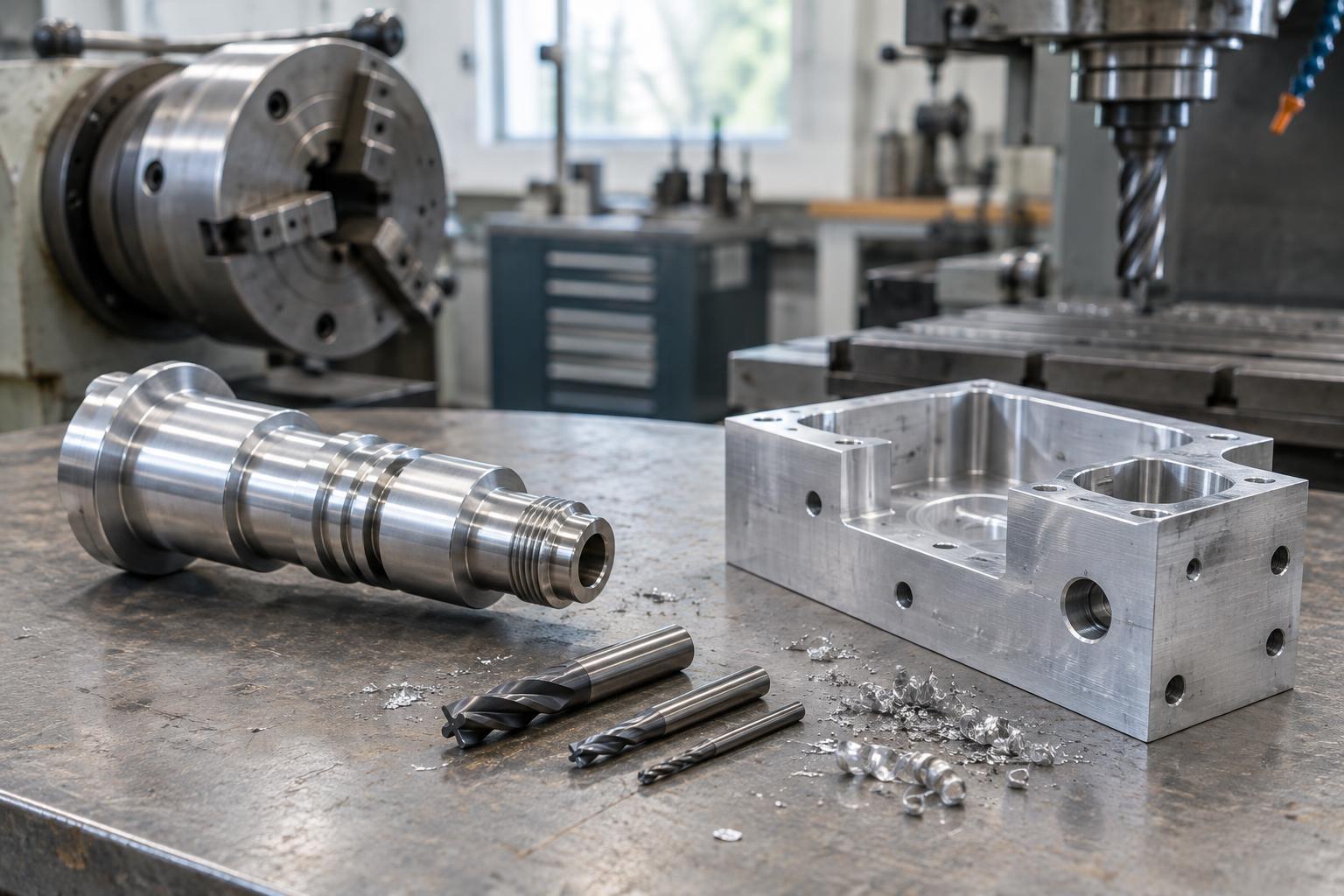
Turning is usually the first process to consider when a part is organized around a central axis: a shaft, pin, sleeve or cylindrical housing. Its familiar features include outside diameters, bores, grooves, tapers and threads. Milling is a natural fit for flat faces, pockets, slots and contours that do not follow a rotational axis. These are starting points, not rigid rules. The useful question is which process can create most of the important geometry while holding and reaching the part reliably.
Read the drawing by its dominant geometry
Imagine a part with several concentric diameters and a bore running through its center. A lathe can often establish those surfaces in one setup, with the rotating workpiece providing a consistent reference axis. That matters when concentricity between features is important. Even if the part has a flat or a cross-hole, turning may still be the sensible primary operation because most of its form is round.
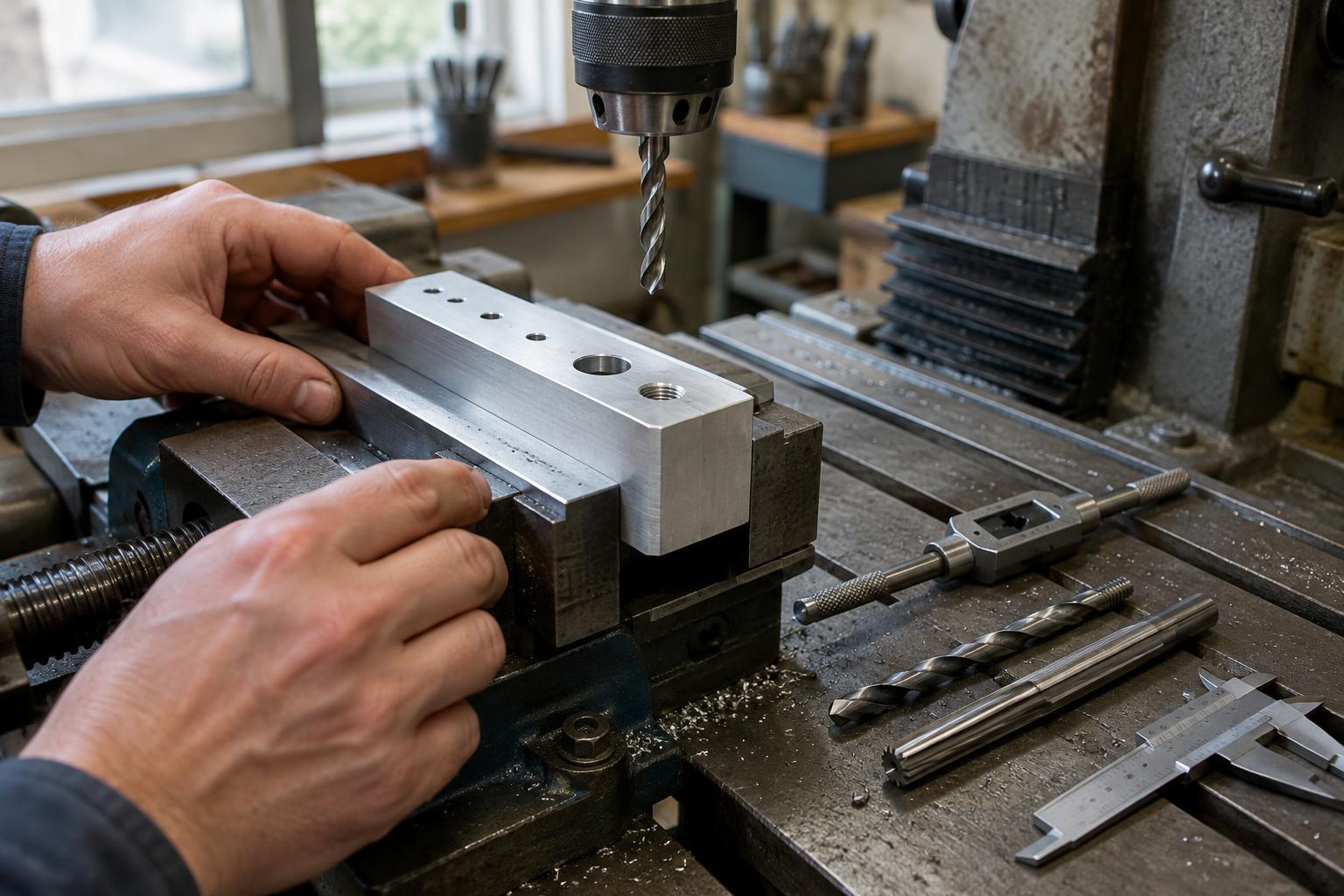
Now consider a rectangular bracket with mounting faces, bolt holes and a recessed pocket. Milling gives the cutter access to those faces and internal shapes without forcing the design into a cylindrical setup. A part that is only roughly round, but has large side cutouts or complex sculpted surfaces, may also spend more of its machining time on a mill. Classifying a part by its raw stock alone can mislead; classify it by the finished surfaces and their relationships instead.
Check access, workholding and setup changes
Geometry must be reachable as well as machinable. A turning tool generally works on surfaces exposed as the part spins. A milling cutter needs a path into each pocket, face or hole, plus enough clearance for the tool and holder. Deep, narrow features may require long tools that are less rigid. Features on opposite sides can require the part to be repositioned, regardless of the process.
Workholding can settle a close decision. A slender turned part may need support to limit deflection, while a thin milled plate may need careful clamping to avoid distortion. Every time a part is moved to another fixture or machine, its position must be established again. That can add handling and make the relationship between features harder to maintain. Where possible, plan a sequence that creates critical related surfaces in the same setup, then check that the remaining operations still have secure clamping and tool access.
Know when the processes overlap
The choice is not always one machine or the other. Some turning centers have driven tools that can drill or mill features while the workpiece is held in the spindle. Some milling machines can use a rotary axis to present different sides of a part to the cutter. These capabilities can reduce transfers for parts that mix round and non-round features, although what is practical depends on the machine, tooling and feature locations.
A separate second operation can also be the better route. Turning a shaft first and then milling a keyway, for example, may be simpler than arranging every feature in one setup. The aim is not to use the most versatile machine available; it is to choose a dependable sequence that meets the drawing without unnecessary handling or complicated tooling.
Make the final choice around the whole part
Before selecting a process, mark the surfaces that control fit and function. Identify which ones share an axis, which must be flat or square to one another, and which are difficult to reach. Then consider the starting stock, how securely it can be held, where material will be removed and how the part will be inspected. Surface finish and dimensional requirements should be evaluated feature by feature rather than assigned to a process by reputation.
Quantity also affects the decision. For a small run, avoiding a complex fixture may outweigh savings in cutting time. For repeated production, a well-planned setup may justify more preparation if it makes each part easier to load and machine consistently. A practical rule is to start with turning when rotational features dominate and milling when prismatic or irregular features dominate, then test that rule against access, workholding and the relationships that matter most on the finished part.