Start with the part, not the machine
Laser, plasma, and waterjet cutting all follow a programmed path to separate material, but they do so in different ways. A laser concentrates light into a small cutting zone. Plasma uses an electrically conductive gas to melt metal and blow it from the cut. A waterjet directs a high-pressure stream of water, often mixed with abrasive, through the workpiece. Those differences determine what happens at the edge and what the shop must do next.
Before choosing a process, define the material and thickness, the required fit, the visible surfaces, and the amount of finishing allowed. A bracket that will be welded may tolerate a rougher edge than a decorative panel. A part that must stay flat or retain its original material properties near the cut may place a higher value on avoiding heat. Quantity matters too: the quickest cut is not necessarily the least expensive finished part.
Laser: precise cuts with a heat-affected edge
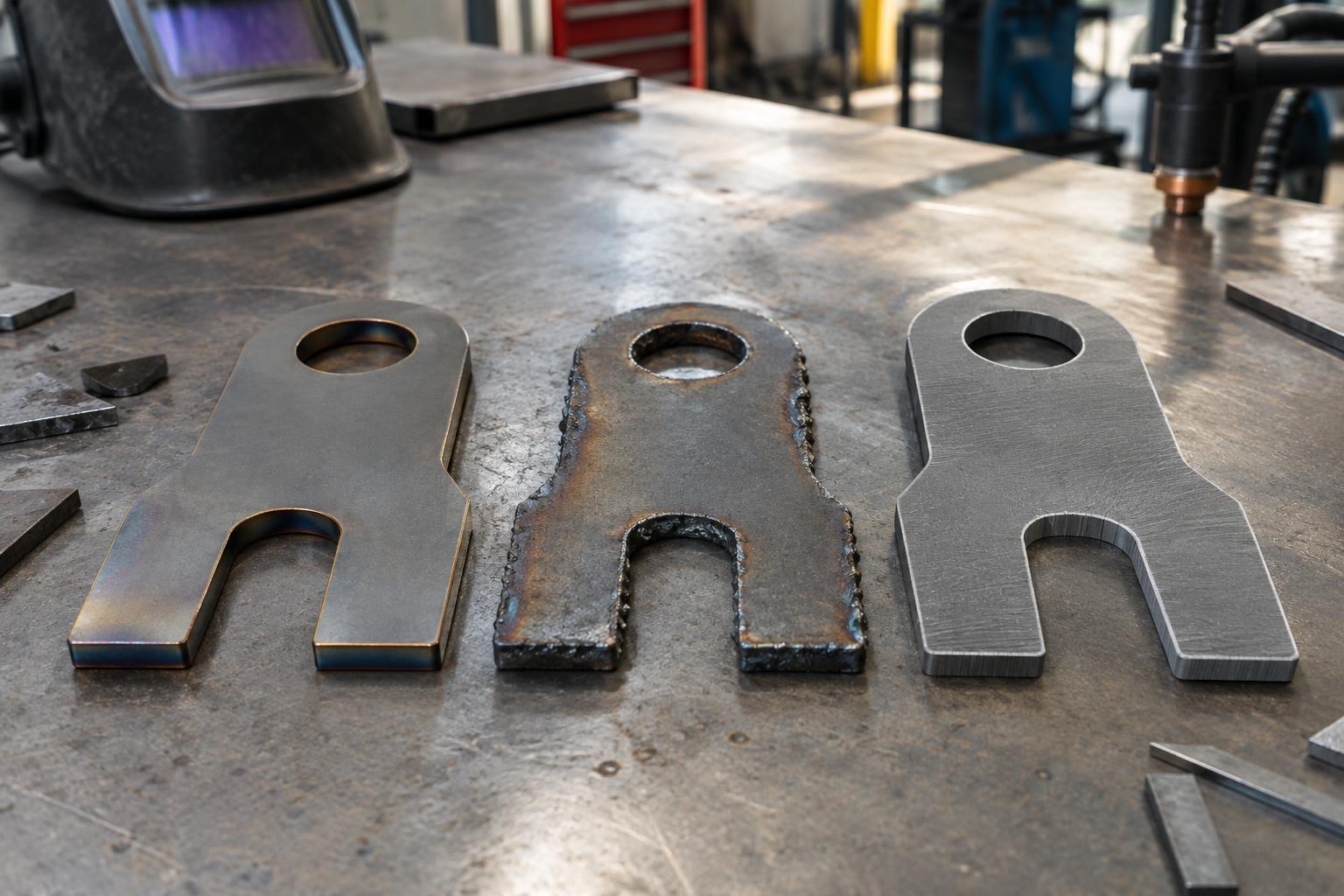
Laser cutting is well suited to detailed profiles, small features, and close-fitting parts, particularly in sheet metal. Its narrow cut can help place parts efficiently on a sheet. On suitable material, it often leaves a clean, consistent edge that needs little preparation. Results still depend on thickness, surface condition, machine setup, and the choice of cutting gas; an edge that looks clean may not be ready for every coating, weld, or visible application.
Because a laser cuts with heat, it changes a narrow region next to the cut. The significance of that heat-affected zone depends on the material and the part’s intended use. Heat can also contribute to distortion, especially in thin parts with long, closely spaced cuts. Sharp internal corners and very small holes need particular attention: a shape that is easy to draw may be difficult to produce to the intended standard.
Plasma: capable cutting for conductive metals
Plasma cutting is a practical option for electrically conductive metals, including steel and aluminum. It is commonly considered when cutting substantial plate or large, relatively simple profiles, where the highest edge precision is not the main requirement. Equipment choice and settings have a strong effect on the result, so the word “plasma” alone does not specify an edge quality.
A plasma-cut edge may show taper, rounding, dross, or a rougher surface than a laser-cut edge. It also has a heat-affected zone, and heat input may cause distortion or complicate later operations. Those effects are not automatic reasons to reject the process: if a component will be ground, welded, or machined after cutting, plasma may fit the production plan well. The important question is how much preparation the edge will need before that next step.
Waterjet: no cutting heat, but not no trade-offs
Waterjet cutting removes material by erosion rather than melting it. That makes it useful when heat could change a material, damage a surface treatment, or warp a delicate part. With an abrasive added, it can cut many materials that a plasma cutter cannot, including stone, glass, and composites, as well as metals. Material suitability still needs checking: water exposure, layered construction, and support during cutting can all affect the outcome.
Waterjet edges avoid a heat-affected zone, but they are not automatically smooth or square. The stream can lag as it passes through thick material, creating taper or visible striations. Slower cutting or process adjustments may improve the edge at added time and cost. Abrasive use, water handling, and equipment maintenance are also part of the operating picture. A waterjet is most compelling when its material range or lack of heat solves a specific problem.
Compare the cost of a usable part
A cutting quote reflects more than the time spent following a contour. Material thickness, total cut length, pierces, setup, nesting, consumables, and expected finish all influence cost. Laser may be attractive for intricate sheet parts that come off the table close to their final form. Plasma may offer a cost advantage on suitable metal profiles where edge cleanup is acceptable. Waterjet may justify a higher cutting cost when it avoids heat-related problems or allows a material to be cut at all. None of these comparisons is universal.
For a useful comparison, specify the same material, drawing, quantity, and acceptance criteria for each process. State whether dross removal, deburring, edge squareness, hole quality, and surface appearance are included. If a later operation will machine a critical edge, a less refined initial cut may be entirely sensible. If the cut edge is the finished edge, paying for a process or setting that reduces rework may be the better decision. The right method is the one that delivers the required part through the whole workflow, not merely the lowest price per cut.