What extrusion does
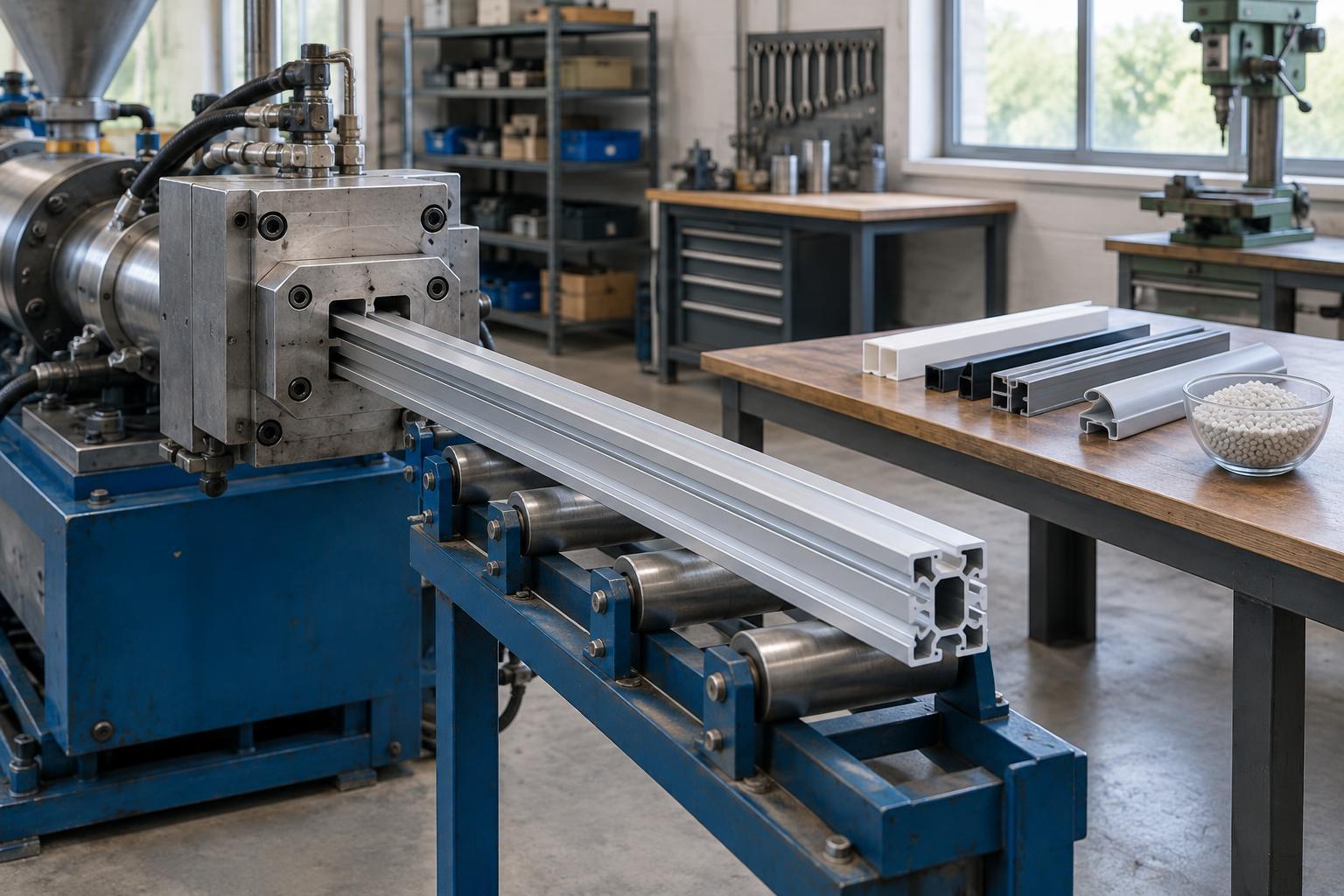
Extrusion is a way to make a long product with a largely consistent cross-section. Material is forced through an opening in a shaped tool called a die. The emerging length, or extrudate, takes on the die’s general shape: a tube, channel, rail, seal or more intricate profile. It can then be cooled, straightened, cut or finished for its intended use.
The comparison to squeezing material through a nozzle is useful, but incomplete. The die alone does not guarantee a good part. Material flow, temperature, pressure and the steps after the die all affect the final dimensions. Extrusion is well suited to shapes needed in repeated lengths; it is less suited to features that must change frequently along a part’s length. Those features may need a later machining or joining operation.
How metal profiles are made
Metal extrusion commonly begins with a billet, a solid length of metal prepared to fit the press. In hot extrusion, the billet is heated to make it easier to deform, then a ram pushes it toward the die. The metal flows through the opening and emerges as a profile. Aluminum is a familiar example, although extrusion methods can be used with other suitable metals and alloys.
A solid bar-like shape can pass through a relatively straightforward die opening. Hollow profiles need tooling that also forms the inside surface, often by supporting a mandrel within the die assembly. That added complexity influences tool design and how the metal flows. Wall thickness, sharp corners and large differences between thick and thin areas deserve attention: uneven flow can make a profile harder to produce consistently.
After leaving the press, a metal profile may be cooled, stretched to improve straightness, and cut to length. Further operations can include machining, surface finishing or heat treatment, depending on the material and specification. These steps matter as much as the initial shaping when a profile must fit another component or present a particular surface.
How plastic profiles are made
Plastic profile extrusion usually starts with pellets fed into a heated barrel. A rotating screw conveys, compresses and mixes the material as it melts, then pushes the melt through a die. Unlike a metal press working from one billet at a time, this process can run continuously while material is supplied and the line remains stable.
The soft profile must keep its shape as it cools. Depending on the product, equipment after the die may guide, size or support it before a puller draws it along the line. It can then be cut into lengths or, if the shape permits, wound onto a reel. A hollow plastic profile may require controlled air inside it or external sizing equipment to hold its dimensions during cooling.
Plastic extrusion is not limited to one recipe or one appearance. Material selection and formulation affect flexibility, stiffness, surface finish and processing behavior. Temperature and puller speed also matter: if the material is drawn too quickly or cools unevenly, the finished profile may not match the intended dimensions.
Designing for a stable process
A useful profile design begins with its job. Which surfaces locate other parts? Which dimensions must stay especially consistent? Does the part need to bend, carry a load or accept a fastener? Answering these questions helps distinguish essential features from details that add tooling difficulty without improving function.
For both metals and plastics, uniformity is helpful but not always possible. Abrupt changes in section thickness can lead to uneven flow or cooling. Long, thin projections may be difficult to form and protect. Small changes to radii, wall thickness or the arrangement of features can sometimes make a profile easier to extrude without changing what it does. The practical limits differ by material and process, so a drawing should be reviewed with the intended production method in mind.
Quality, offcuts and resource use
Extrusion defects can reveal what is happening along the line. A profile that twists or bows may have experienced uneven flow, cooling or handling. Surface marks can come from tooling, material condition or downstream contact. Dimensional checks at several points, rather than only at the start of a run, help show whether the process remains stable.
Because extrusion makes long lengths, it can reduce the need to remove large amounts of material from a solid block. It is not waste-free: start-up lengths, trim, rejected profiles and finishing operations all use resources. Separating suitable metal scrap for recycling and managing plastic offcuts by material type can make recovery more practical. Above all, a profile designed for reliable production and the right service life avoids repeated runs to replace parts that did not meet their purpose.