A sheet, a tool and a controlled change of shape
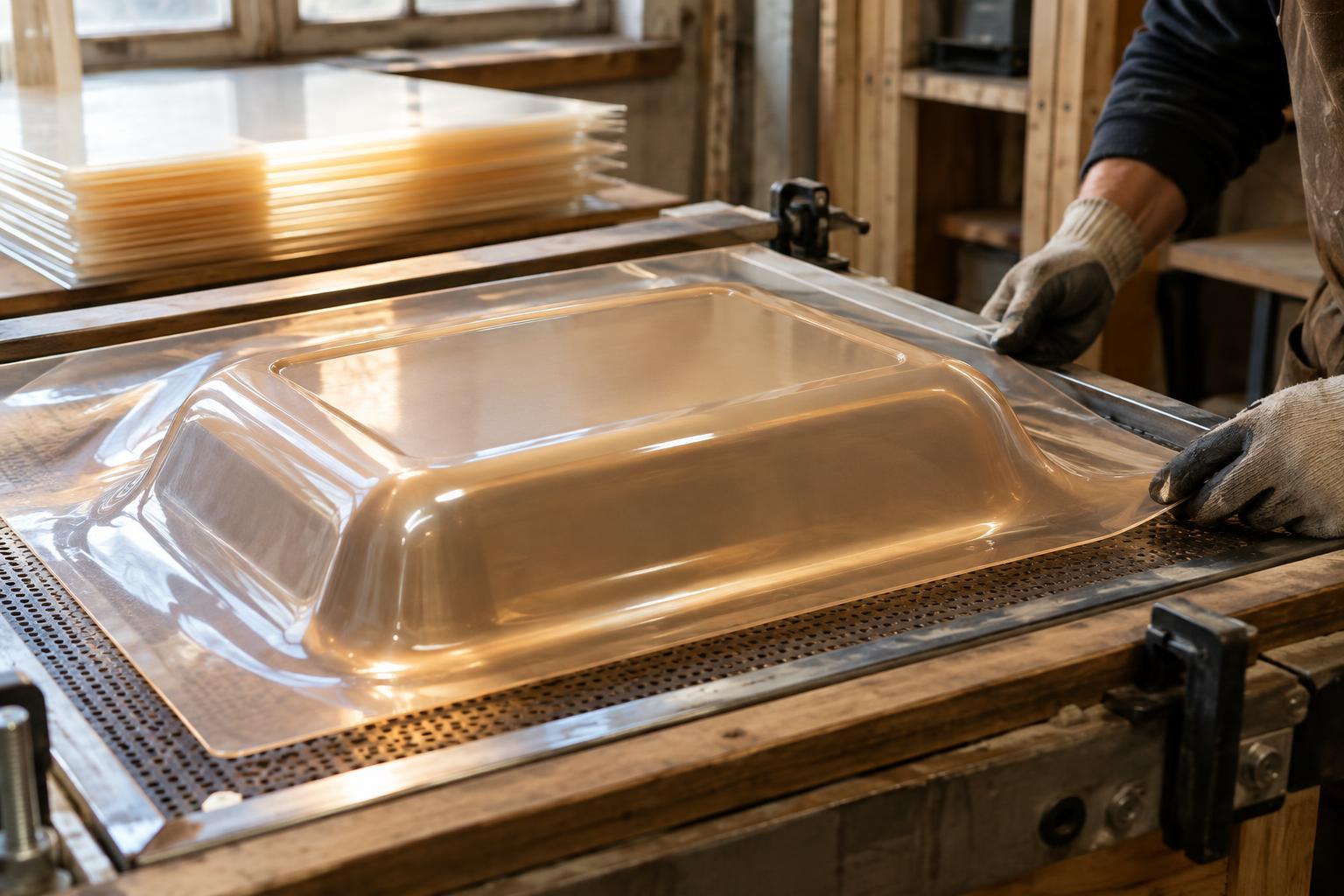
Thermoforming begins with a sheet of thermoplastic: a material that softens when heated and becomes firmer again as it cools. The sheet is held in a frame, heated until it can stretch, then drawn over or into a shaped tool. Once the plastic has cooled enough to retain the tool’s form, the part is removed and trimmed. Packaging trays, equipment covers and protective housings are examples of the kinds of shapes this method can produce.
The sequence sounds simple, but the result depends on how evenly the sheet heats, where it first touches the tool and how far each area must stretch. Thermoforming does not add material to thin spots as a part is shaped. It redistributes the material already in the sheet, so the starting thickness and the geometry of the tool both matter.
How the sheet takes the tool’s shape
In vacuum forming, air is removed from between the warm sheet and the tool. The resulting pressure difference pulls the plastic against the tool surface. Pressure forming adds air pressure on the opposite side of the sheet, which can help reproduce finer surface details. Some processes also use a mechanical plug to push part of the sheet toward a deep area before vacuum or pressure completes the shape. The right approach depends on the required detail, depth and material.
Tools are often described as male when the sheet forms over a raised shape and female when it is drawn into a cavity. That choice affects which surface is controlled most directly by the tool and where stretching occurs. Small openings in the tool let trapped air escape; without them, the sheet may bridge over details rather than settle against them. Tool design must also allow the cooled part to be released without damage.
Designing for thickness and release
A formed part rarely has exactly the same wall thickness everywhere. Deep corners and tall sidewalls may become thinner because the sheet has to travel farther to reach them. Broad transitions and generous corner radii can make that stretching less severe than abrupt changes in shape. For demanding parts, a prototype or trial tool can reveal thin areas before a production tool is finalized.
Draft angles—slight slopes on walls—help a part lift away from the tool. Sharp undercuts, which hook beneath a feature of the tool, make release difficult and may call for a different design or more complex tooling. Designers also need to consider what happens after forming: openings, edges and mounting features may have to be cut or machined. Leaving suitable flat areas and trim allowances can make those later operations more consistent.
Heating, cooling and trimming in production
Before forming, the sheet must reach a workable temperature across the area that will become the part. If one region is too cool, it may resist stretching; if another is too hot, it may sag or thin excessively. Different plastics have different forming behavior, and sheet color, texture and thickness can influence how they absorb heat. A repeatable process therefore relies on controlling the sheet, heater settings and forming cycle together.
Cooling is part of shaping, not merely a wait before removal. The plastic needs enough time against the tool to hold its geometry, yet uneven cooling can contribute to distortion. After release, the surrounding sheet is trimmed away, and the part may receive drilled holes or other finishing work. This produces offcuts, including the outer frame of material that held the sheet. Whether those offcuts can be reused depends on the material, cleanliness and available recycling process.
Where thermoforming fits
Thermoforming is well suited to parts whose main shape can be made from a sheet, especially when a relatively large surface or shallow shell is needed. Its tooling may be simpler than tooling for some other plastic-shaping methods, but a finished thermoformed part can still require substantial trimming and assembly. It is less natural for shapes that need intricate internal passages, thick solid sections or features on every side.
Choosing the method means looking beyond the forming step. The useful questions include how thick the finished walls must be, which surfaces need detail, how many parts are expected and how much sheet will be cut away. A design that forms cleanly, releases reliably and places trim lines thoughtfully can save material and workshop effort. Thermoforming works best when the sheet’s movement is treated as a design constraint from the beginning, rather than a problem to fix after the first parts come off the tool.