A material with a preferred direction
A fiber-reinforced composite combines fibers with a surrounding matrix, often a polymer resin. The fibers provide much of the stiffness and strength along their length; the matrix holds them in place, helps transfer load between them and protects them from damage. That partnership makes the material useful, but it also means a composite sheet does not behave like a uniform sheet of metal.
Consider a strip made with straight fibers running from end to end. Pull it lengthwise and the fibers can carry much of the load. Pull it across its width and the response depends more heavily on the matrix and on how well load transfers between fibers. This directional behavior is called anisotropy. It is not a flaw to eliminate automatically: it lets a designer place material where it does the most work.
Match the fibers to the load
The first question in choosing a fiber layout is what the part must resist. A tie or strap mainly loaded in tension may benefit from fibers aligned with the pull. A panel that must resist bending needs a different view: material farther from the panel’s middle contributes strongly to bending stiffness, so the orientation of the outer layers can matter greatly. Parts that twist or carry loads in more than one direction may need fibers at several angles.
A common laminate approach is to stack thin layers, or plies, with different orientations. Lengthwise fibers help with loads along the part; crosswise fibers support transverse loads; angled fibers can help carry shear and twisting loads. A balanced, symmetric stack can also help limit unwanted coupling, such as bending accompanied by twisting. There is no universally best sequence, however. Thickness, shape, loading and the way layers are joined all affect the result.
Fabric form changes the picture
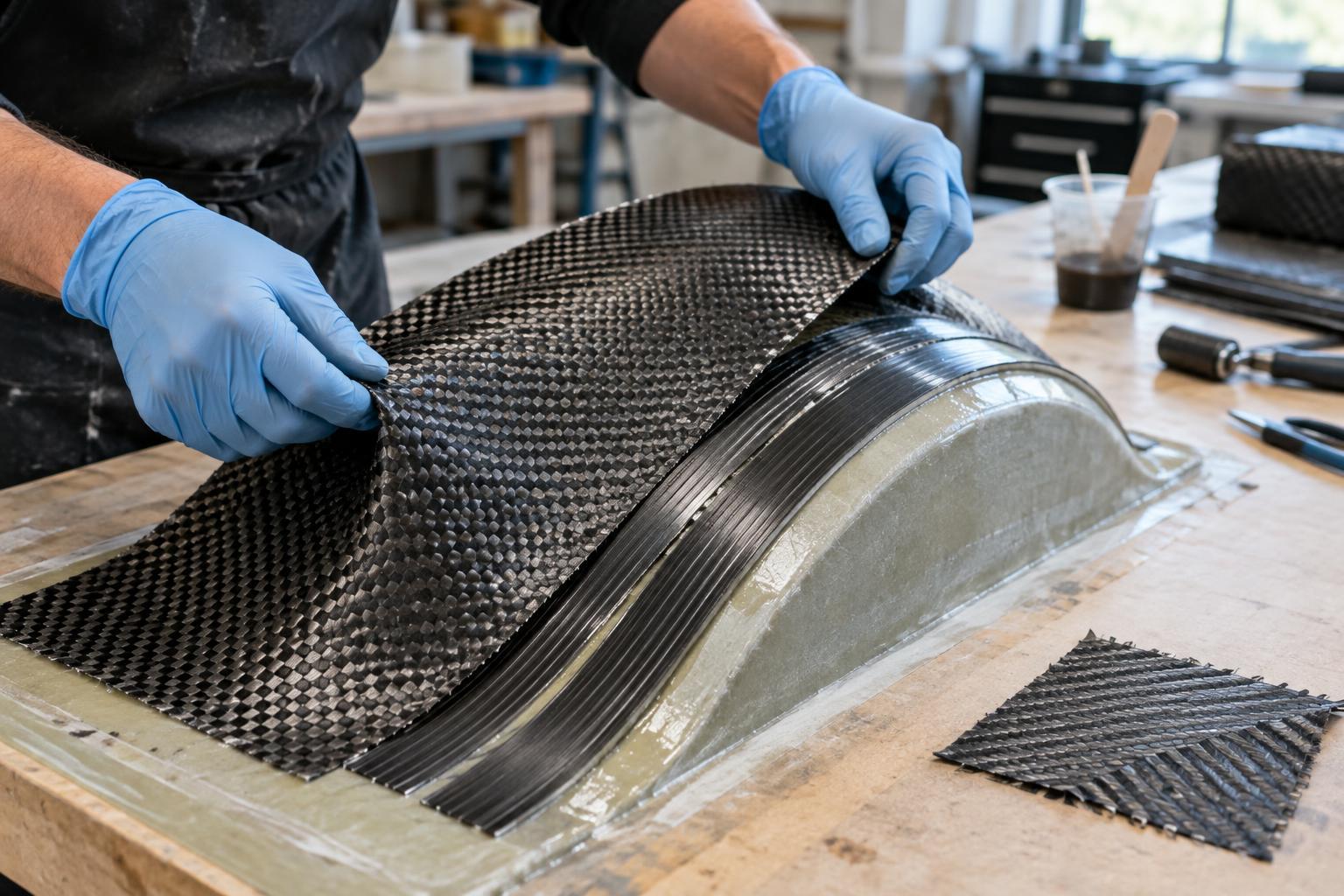
Fibers can be supplied as straight, unidirectional material or as woven fabric. Unidirectional layers make the main fiber direction especially clear and allow precise choices in a laminate. Woven fabric has fibers in two directions and can be convenient to handle, particularly for shapes that need a fabric to drape over them. Its interlaced yarns bend around one another, though, so woven and straight fibers should not be assumed to perform identically even when their nominal directions match.
Fiber direction is also a three-dimensional issue. Most fibers in a conventional laminate lie within the surface of the part. Loads that try to peel layers apart act through the thickness, where the laminate may be more vulnerable. A part can therefore look well reinforced in plan view yet still need careful attention at an edge, a corner or a bonded attachment.
Corners, holes and joints deserve special attention
Loads rarely enter a finished part as neatly as they do in a simple drawing. A bolt hole interrupts fibers and concentrates load near its edge. A sharp change in shape can redirect stresses, while an abrupt end to a reinforcing ply can create a locally stiff region beside a more flexible one. These details may encourage cracking in the matrix or separation between layers even if the broad, flat area of the part performs well.
Good layout begins by tracing a plausible load path from where force enters to where it leaves. Keep important fibers continuous along that path where practical. Around joints and openings, consider how the remaining fibers share the load, rather than counting only the total amount of reinforcement. Gentle transitions, suitable local reinforcement and a joint designed for the actual direction of force are often more valuable than simply adding layers everywhere.
Design for a layout the workshop can make
The planned orientation must survive cutting, placement and forming. On a curved mold, fabric may shift or wrinkle as it drapes; on a flat layup, a ply placed at the wrong angle can change the intended response. Clear reference marks and a consistent ply sequence help a workshop build the part that was designed. Inspecting corners, ply edges and areas around inserts is especially useful because defects there may be difficult to see after the part is finished.
More fiber is not always a better answer. Extra layers add material, labor and thickness, and they may introduce new transitions that need care. A sound design uses enough reinforcement in the directions that matter, while remaining practical to manufacture and repair. Fiber direction connects material choice to product shape and workshop practice: it is a design decision, not just a property printed on a material sheet.