Why small leaks deserve attention
Compressed air is convenient for cleaning, clamping, spraying and powering tools, but it takes electricity to produce. Air escaping through a loose fitting or worn hose has already used that energy without doing useful work. Leaks can also make pressure less predictable at a workstation, particularly when several tools run at once. A workshop does not need a perfect system to benefit from leak control; it needs a repeatable way to find and address avoidable losses.
The most revealing time to check is often when production stops. With tools idle, a hiss is easier to distinguish from normal machine noise. If a compressor continues to cycle while all intended air users are off, a leak may be one explanation. That observation alone does not identify its location: automatic drains, connected equipment and other legitimate air demands may also affect compressor operation.
Start with a safe, systematic search
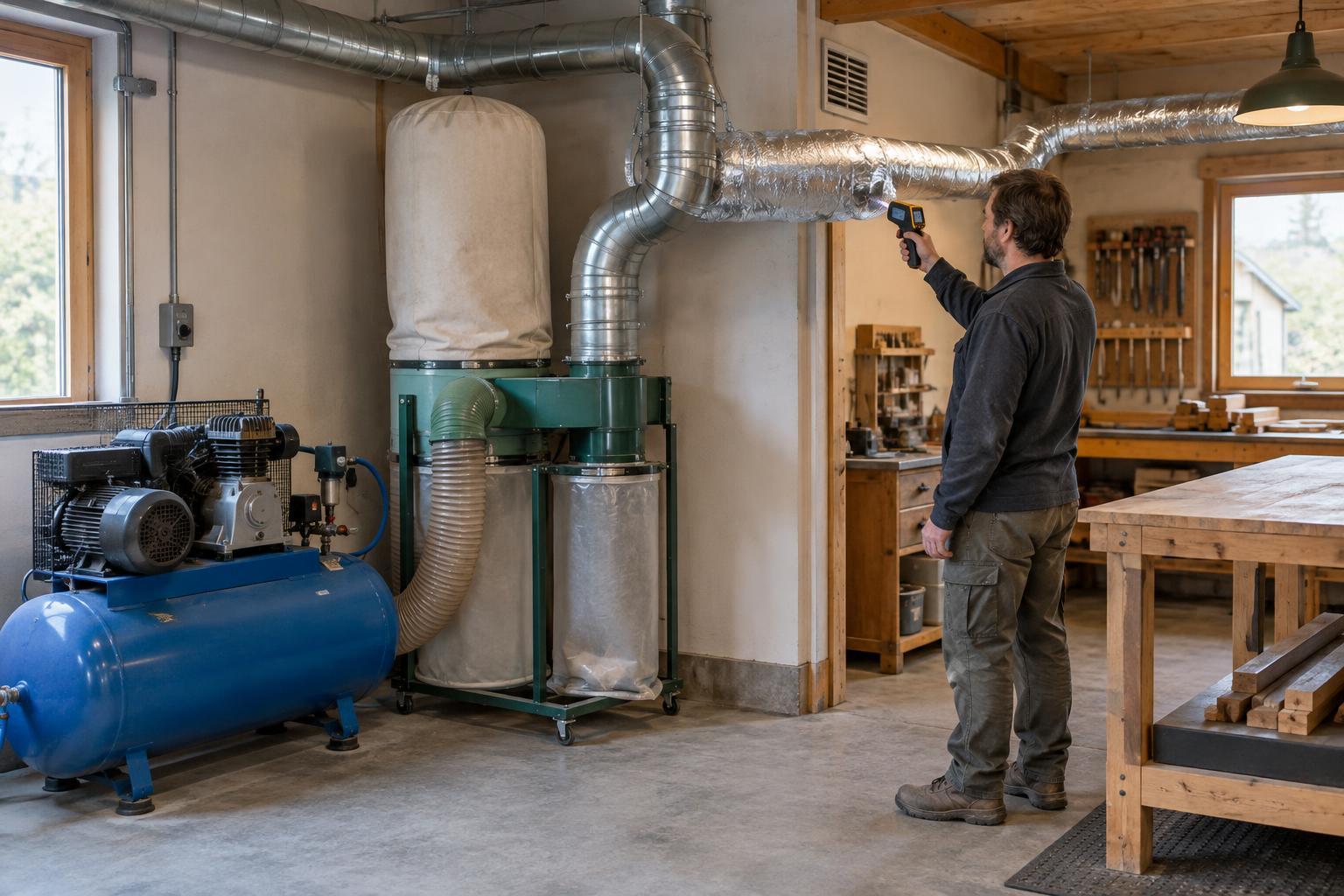
Walk the air route from the compressor and receiver through filters, regulators, distribution lines, drops and end-use connections. Common places to inspect include quick-connect couplings, hose ends, threaded joints, drain valves and flexible lines that are repeatedly bent or dragged. Listen for escaping air, then look for damaged tubing, loose connections or hoses that rub against an edge. Record the location of each suspected leak so the same spots can be checked again after repair.
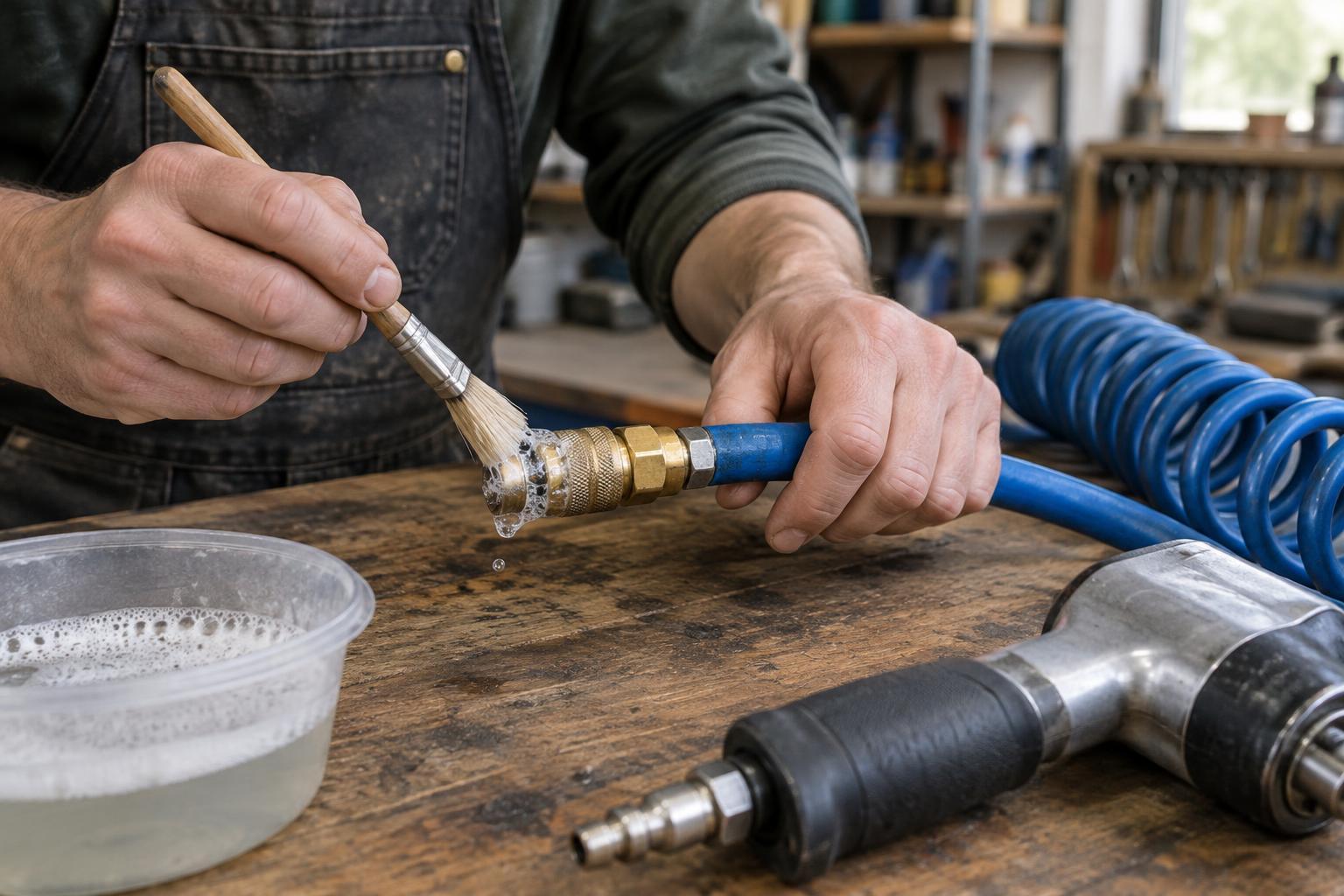
A leak-detection solution suitable for the equipment can help confirm a suspected joint: applied to the outside of a connection, it forms bubbles where air escapes. Follow the product and equipment instructions, and keep liquids away from electrical components and surfaces they could damage. In a noisy shop or around inaccessible pipework, an ultrasonic leak detector may make a survey easier if one is available. Neither method replaces an inspection of how the line is supported and used.
Treat compressed air as stored energy. Do not use a hand to search for leaks at close range, and do not loosen fittings or cut hose while a line is pressurized. Before repair, isolate the affected section, relieve its pressure and confirm it is depressurized using the workshop’s established procedure. Equipment that cannot be isolated or reached safely should be left to someone qualified to work on it.
Prioritize the repairs that matter most
A leak log turns scattered observations into a manageable job list. Note the component, its position, whether it leaks continuously or only during use, and any effect on tool performance. Mark problems that create an immediate safety concern separately from routine maintenance. A damaged hose in a walkway or a connection close to an operator needs prompt attention regardless of how much air it appears to lose.
For the rest, start with continuous leaks and faults that are simple to isolate and repair. A failed coupling at the end of a hose may be straightforward; a leak inside a complex machine may require a planned stop and further diagnosis. Avoid judging severity by sound alone. A clearly audible hiss is worth investigating, but a quieter leak that persists through every closed shift can also add up.
Repair the cause, then verify the result
A lasting fix depends on the failed part. It might mean replacing a worn seal, a damaged hose or an unreliable connector rather than repeatedly tightening a joint. Use components suitable for the system’s pressure and application, and follow equipment instructions for assembly. Over-tightening can damage threads or seals; adding sealant to the wrong connection can create another problem. If a fitting keeps leaking, check for misalignment, unsupported pipework or a hose that pulls on it during normal work.
After reassembly, restore pressure according to the workshop procedure and test the repaired area again. Check it both at rest and, where appropriate, during the tool’s normal movement. Close the log entry only when the leak is no longer apparent and the connection remains secure. If compressor cycling was the original clue, compare its behavior under similar idle conditions rather than assuming one repaired joint explains the whole system.
Make leak checks part of workshop upkeep
Leak control works best as a small, regular task rather than an occasional search after performance deteriorates. Encourage operators to flag hissing couplings and damaged hoses as they encounter them. Set aside a quiet period for a more deliberate walk-through, and keep the log accessible to whoever schedules maintenance. Tagging a fault can help the repairer find it without requiring a second search.
Prevention also comes from layout and handling. Keep hoses out of traffic where practical, support lines so fittings do not carry their weight, and protect connections that are frequently pulled or knocked. Review recurring failures before buying another identical replacement: a different hose route or a better-supported drop may do more than another new fitting. The aim is a system that delivers air where it is useful, with less effort spent making up for air that escapes along the way.