Start with the joint, not the machine
A welding method is a good fit only if it can make the required joint consistently in the available workspace. Material type and thickness matter, but so do access to the joint, the shape of the parts, the desired appearance, and how many assemblies must be made. A long seam on a frame calls for a different approach from a small, visible joint or a series of overlaps in sheet metal.
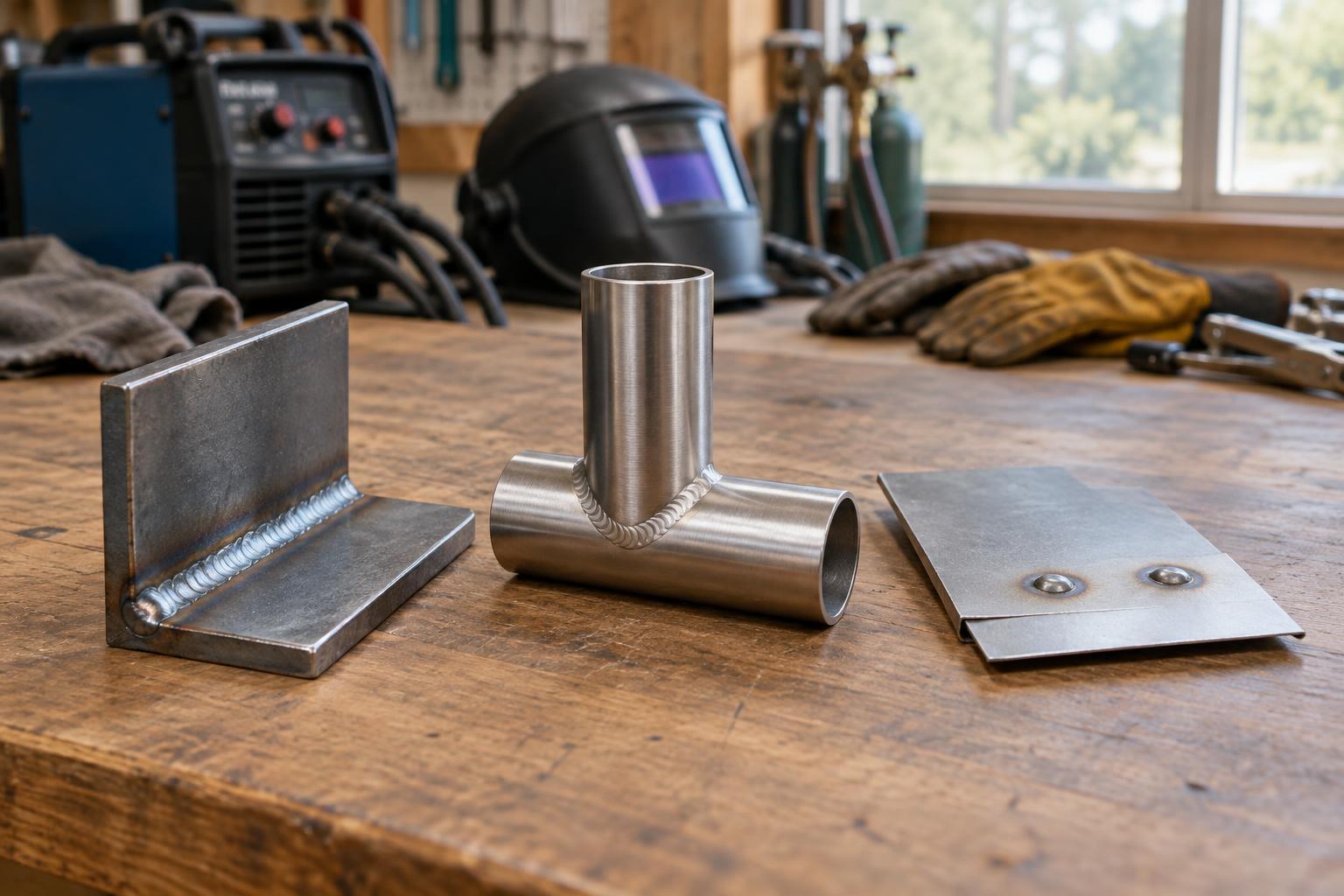
MIG and TIG are arc-welding methods: an electric arc melts metal at the joint, while shielding gas helps protect the molten weld from the surrounding air. Spot welding usually means resistance spot welding, which passes current through overlapping sheets held between electrodes. It forms a localized joint without a continuous seam. That distinction is often the quickest way to narrow the choice.
MIG: a practical choice for many seams
In MIG welding, a wire is fed continuously through a welding gun. The wire serves as the electrode and normally becomes part of the weld. The process is also called gas metal arc welding; despite the familiar name “MIG,” the shielding gas is not always inert. A welder can move along a joint without stopping to add filler separately, making the method useful for frames, brackets, enclosures, and other parts with repeated seams.
MIG often fits work where production pace and consistent results matter more than the finest possible control over a tiny weld pool. It can be used on a range of metal thicknesses when the equipment, consumables, and settings suit the job. Still, it does not remove the need for preparation. Poor fit-up, contamination, or an awkward welding position can affect the result. Spatter and the shape of the finished bead may also matter when a surface will remain visible.
TIG: control for demanding or visible joints
TIG welding uses a non-consumable tungsten electrode to create the arc. Filler metal, when needed, is added separately. This separation gives the welder close control over heat and filler addition, which can be valuable on thin material, small details, and joints where appearance is important. It is commonly considered for carefully fitted stainless steel or aluminum work, as well as repairs that require a controlled approach.
That control comes with demands. TIG generally calls for clean material, accurate fit-up, steady access, and more operator attention than a continuous-wire process. It may be slower for a long run of ordinary seams. A neat-looking bead is not, by itself, proof of a sound joint, and TIG is not automatically the best choice for every precision part. If the joint is difficult to reach or production volume is high, the time required can outweigh the benefit of finer control.
Spot welding: fast joints in overlapping sheet
Resistance spot welding is built around a specific joint geometry: sheets overlap, and electrodes can press against opposite sides. Pressure and electrical resistance generate heat at the contact area, forming a weld nugget. Because each weld is localized, the method suits assemblies that can be secured with a planned pattern of spots rather than a continuous bead.
Spot welding can be efficient for repeated sheet-metal assemblies, especially when fixtures position parts reliably and both sides remain accessible. It also avoids adding filler wire to each joint. Its limits are just as important: an edge-to-edge seam is not a typical spot-welding task, and electrode access can rule out an otherwise promising design. Sheet condition, overlap, electrode condition, and consistent positioning all influence results. Where a joint must seal against water or air, a row of spots alone is generally not a substitute for a continuous seal.
Choose for the whole workflow
A useful comparison begins with a sketch of every joint. Mark whether it is a continuous seam or an overlap, which sides a tool can reach, and which surfaces will be seen. Then consider the number of parts, the time available for fitting and cleaning, and how the finished joint will be inspected. This can reveal, for example, that MIG is sensible for most of a frame while TIG is worth considering for a small exposed detail.
The surrounding workshop matters too. Each method needs suitable equipment, ventilation, protective practices, and people trained to use and check the process. Fixtures may have as much effect on repeatability as the choice of welding machine. Treat the method as one part of a production plan: design an accessible joint, prepare it consistently, and confirm that the finished assembly meets its intended requirements.