Start with the job the joint must do
A wood joint has more to do than hold two pieces together. It may need to keep a frame square, resist racking, preserve a clean visible surface, or make assembly straightforward. The best method depends on the parts being joined, the direction of expected loads, the tools available, and whether the piece might need to come apart later.
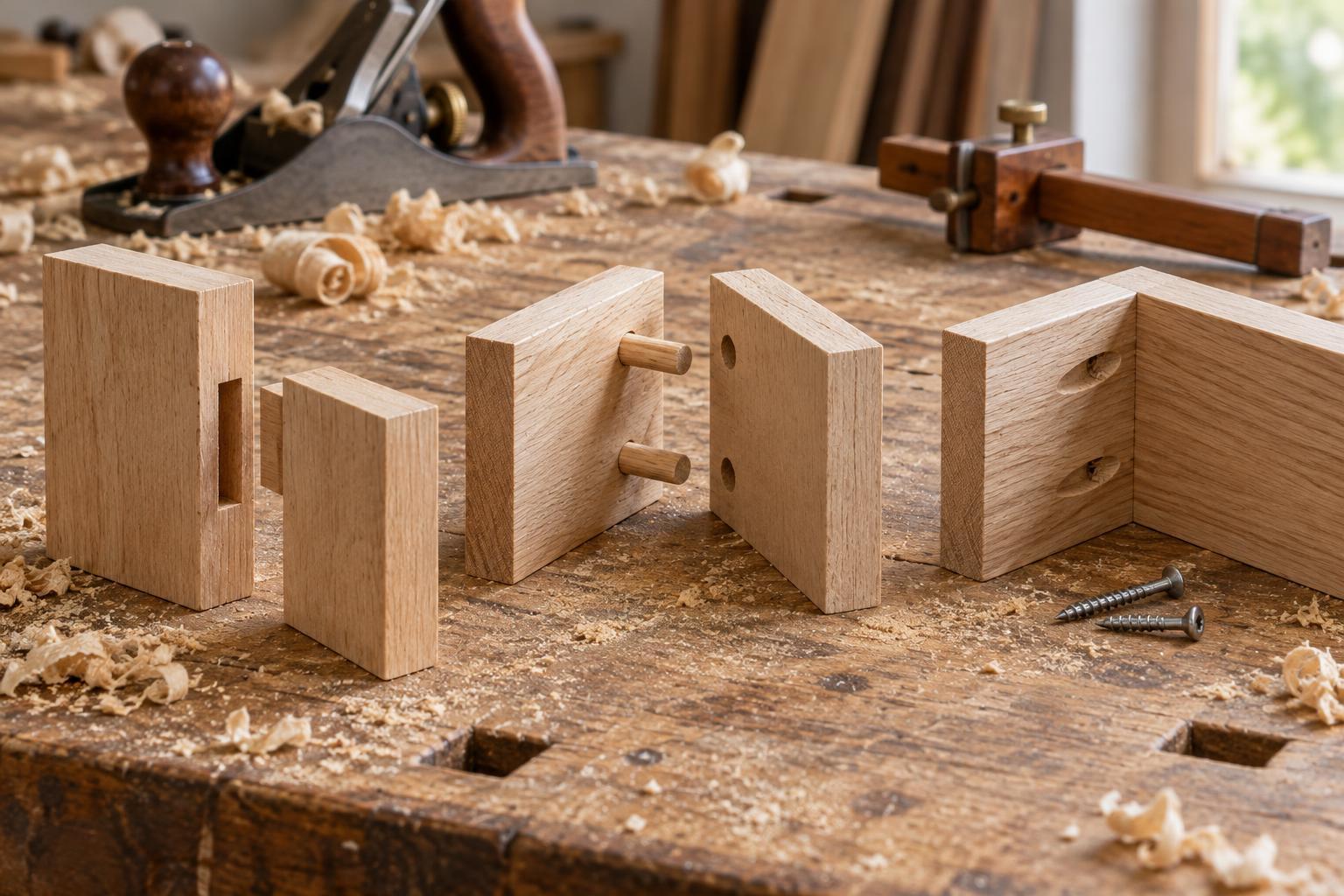
Mortise-and-tenon, dowel, and pocket-hole joinery approach those needs differently. A mortise-and-tenon joint fits a shaped projection into a matching recess. A dowel joint uses separate round pins to connect drilled holes. A pocket-hole joint drives a screw at an angle through one part into another. None is automatically the strongest choice for every project: wood species, dimensions, fit, glue coverage, screw placement, and workmanship all affect the result.
Mortise-and-tenon: a fitted connection
In a mortise-and-tenon joint, a tenon cut on the end of one member enters a mortise in the other. The broad mating faces provide space for glue, while the fitted shape helps locate the parts and resist twisting. This makes the method useful for frames, such as doors, tables, and chairs, where a rail meets a post or leg.
The work lies in laying out and cutting both parts accurately. A loose fit may reduce glue contact and allow movement; a fit that is too tight can make assembly difficult or damage the surrounding wood. The maker must also leave enough material around the mortise and size the tenon to suit the stock. Mortises and tenons can be cut with hand tools, machines, or a combination, but they generally take more setup and fitting than the other methods discussed here.
The joint can be hidden within the finished piece or deliberately exposed as a design detail. That flexibility is valuable when the connection itself contributes to the appearance, though it calls for careful decisions early in the design.
Dowels: hidden pins and careful alignment
Dowel joinery connects parts with short wooden pins inserted into matching holes, usually with glue. Because the pins sit inside the work, they can produce a clean exterior without a visible screw head or a shaped tenon. Dowels are useful for joining boards edge to edge and for many frame or cabinet connections where concealed alignment matters.
The main challenge is making corresponding holes meet. Even a small error in location or drilling angle can leave faces out of flush or prevent the joint from closing. A suitable drilling jig or machine setup helps make results repeatable. Hole depth also matters: a dowel needs room to seat fully, and excess glue must have a path or space during assembly.
Dowel size, number, and spacing should suit the thickness of the pieces. More pins are not necessarily better if they crowd an edge or leave too little wood between holes. A dry fit before gluing is an efficient way to find alignment problems while they can still be corrected.
Pocket holes: fast fastening from one side
Pocket-hole joinery uses an angled hole, typically made with a jig, to guide a screw through one piece and into another. It requires no matching hole in the second part and usually needs less fitting than a mortise-and-tenon or dowel joint. That makes it practical for some cabinet frames, built-ins, and workshop projects where rapid assembly and access from one side are important.
The screw supplies the immediate hold, so parts can often be assembled without waiting for glue to set. Pocket holes are normally placed on a back, underside, or other less visible face; plugs can conceal them, but may remain noticeable on a show surface. The connection also relies on sound screw engagement. Choosing a screw suited to the material and thickness, and clamping parts so they do not shift as the screw tightens, helps avoid common assembly problems.
A pocket-hole screw can often be removed, but repeated disassembly may wear its grip in the wood. Where a joint must resist substantial racking or carry demanding loads, consider how the whole structure is supported rather than relying on the screw connection alone.
Choose by appearance, process, and structure
For a visible, long-lived frame connection, mortise-and-tenon joinery may reward the extra layout and cutting time. For a concealed glued joint made with repeatable drilling, dowels may be a good fit. For quick assembly where angled access and hidden holes are available, pocket holes can simplify the work.
Before committing, make a sample using the same stock and thickness as the project. Check whether the pieces register flush, whether clamps or a driver can reach the joint, and whether the finished connection looks acceptable from every exposed side. A sound choice is not just the joint that is quickest to make; it is the one the workshop can produce consistently for the product’s intended use.