Recycled content is not a single material property
A component described as containing recycled material may be made with carefully sorted production offcuts, mixed post-use material, or a blend of recycled and virgin feedstock. Those inputs can behave differently even when they share a broad material name. Knowing the recycled percentage is useful, but it does not by itself tell a designer how reliably a part will perform.
The more useful questions concern composition, condition and consistency. Has the feedstock been sorted by grade? Could it contain coatings, adhesives or other materials? Has it been heated or processed before? Answers help identify which properties may change and which checks matter for the finished component. Recycled content works best as a design consideration alongside strength, appearance, tolerances and expected service conditions—not as a substitute for them.
Where feedstock variation comes from
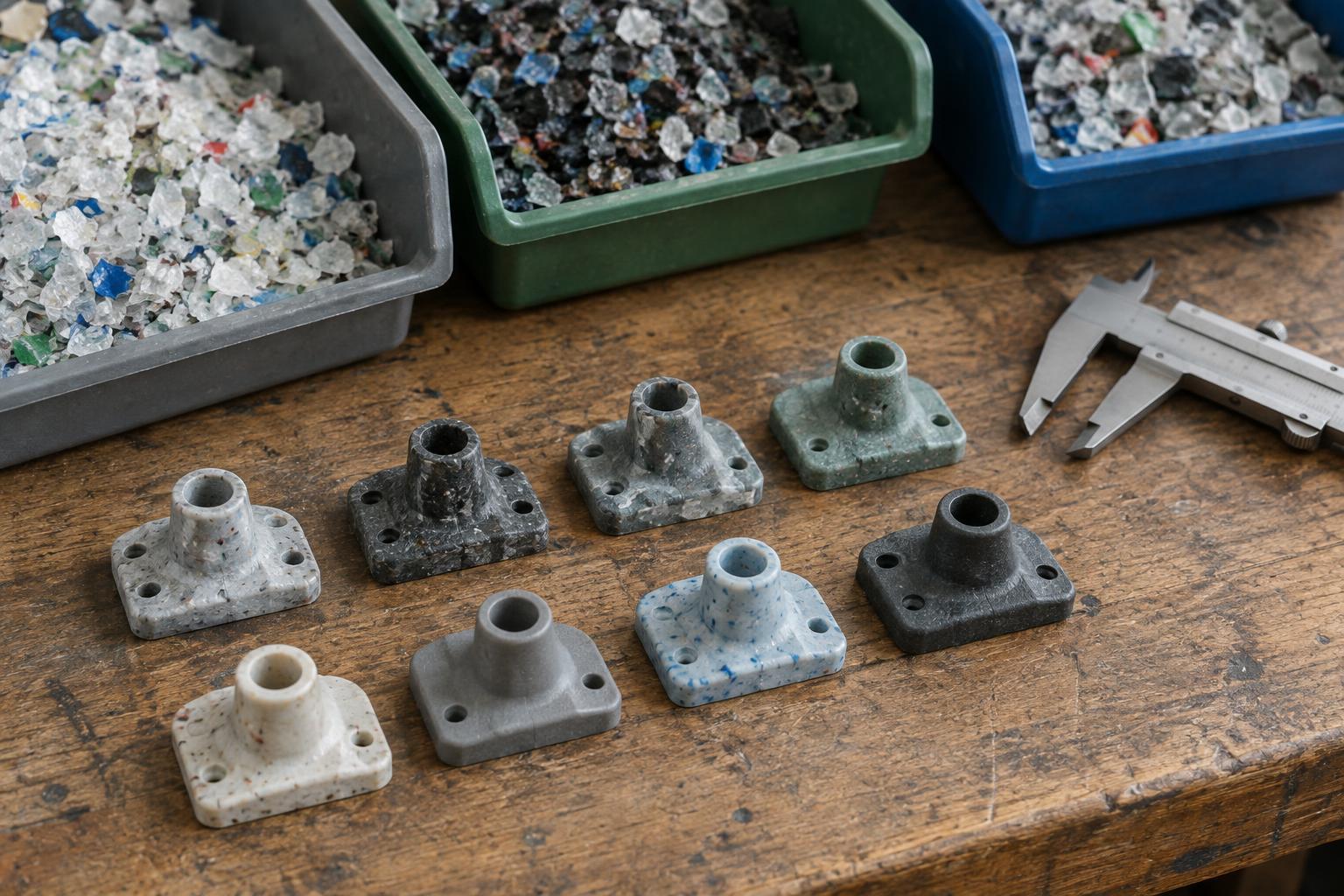
Sorting is one source of variation. Similar-looking metals may have different alloy compositions, while plastic parts marked with the same polymer family may contain different additives or fillers. Mixing grades can shift how a material melts, flows, forms or finishes. Small amounts of an incompatible material can also cause visible defects or weak points, depending on the process and the component.
Condition matters as much as identity. Dirt, moisture, paint and residual adhesives may be carried into a recycling stream unless they are removed or managed. Repeated processing can change some polymers’ behavior; metal scrap may bring coatings or elements that affect a later melt. Even particle size and shape can influence feeding and mixing. None of these effects means recycled feedstock is inherently unsuitable. They mean its history deserves attention when repeatable quality is the goal.
How variation shows up in components
A change in feedstock can appear first on the workshop floor. Material may need different forming conditions, produce more scrap during setup or finish less evenly. In a molded polymer part, changes in flow or moisture can affect surface appearance and dimensions. In a cast metal part, composition and contamination can influence how consistently the melt fills a mold and how the surface responds to finishing. The details depend on the material and method.
Some variation is cosmetic; some affects function. Color differences may be acceptable in a concealed bracket but not in a visible panel. A dimensionally sensitive fitting may have little room for changes in shrinkage, while a decorative object may allow more flexibility. Quality decisions therefore start with the component’s job. Naming the critical features prevents a team from rejecting harmless variation while overlooking changes that matter in use.
Build specifications around the part’s purpose
A practical specification describes the outcome the component must achieve as well as any limits on the feedstock. It may identify permitted material grades, unacceptable contaminants, required dimensions, surface expectations and the properties that need verification. For visible products, an agreed range of color or texture can be more workable than an unspoken expectation that every batch will look identical.
The amount of control should fit the risk. A noncritical trim piece may call for a visual check and basic dimensional inspection. A part carrying a significant load may need tighter material identification and more extensive testing before a feedstock change is accepted. When developing a component, representative trial batches can reveal process sensitivity that a sample made from one unusually clean batch might hide. Keeping sample results tied to feedstock batches makes later differences easier to investigate.
Make consistency a shared workshop practice
Reliable use of recycled material depends on communication between sourcing, design and production. Incoming material can be labeled by batch and checked for obvious contamination before it is mixed with other stock. Recording the feedstock used for each production run gives the workshop a starting point if defects appear. Simple records of settings, rejects and observed changes may be more useful than a recycled-content figure kept apart from production notes.
Designers can also make room for reasonable variation. A finish that celebrates subtle material differences may suit an object whose appearance is not required to be uniform. Parts with tight tolerances or demanding surfaces may need a narrower input specification or a controlled blend. The aim is not to accept every batch or to demand impossible uniformity. It is to understand which variations the component can tolerate, detect those it cannot, and use material with less avoidable waste.