What an insulation material needs to do
Thermal insulation slows the movement of heat through a wall, roof, enclosure, or product. Most common insulation materials do this by holding pockets of gas in fibers or cells. Their published thermal performance is useful for comparison, but it does not tell the whole story: gaps, compressed areas, fasteners, and poorly fitted edges can change the performance of an assembled component.
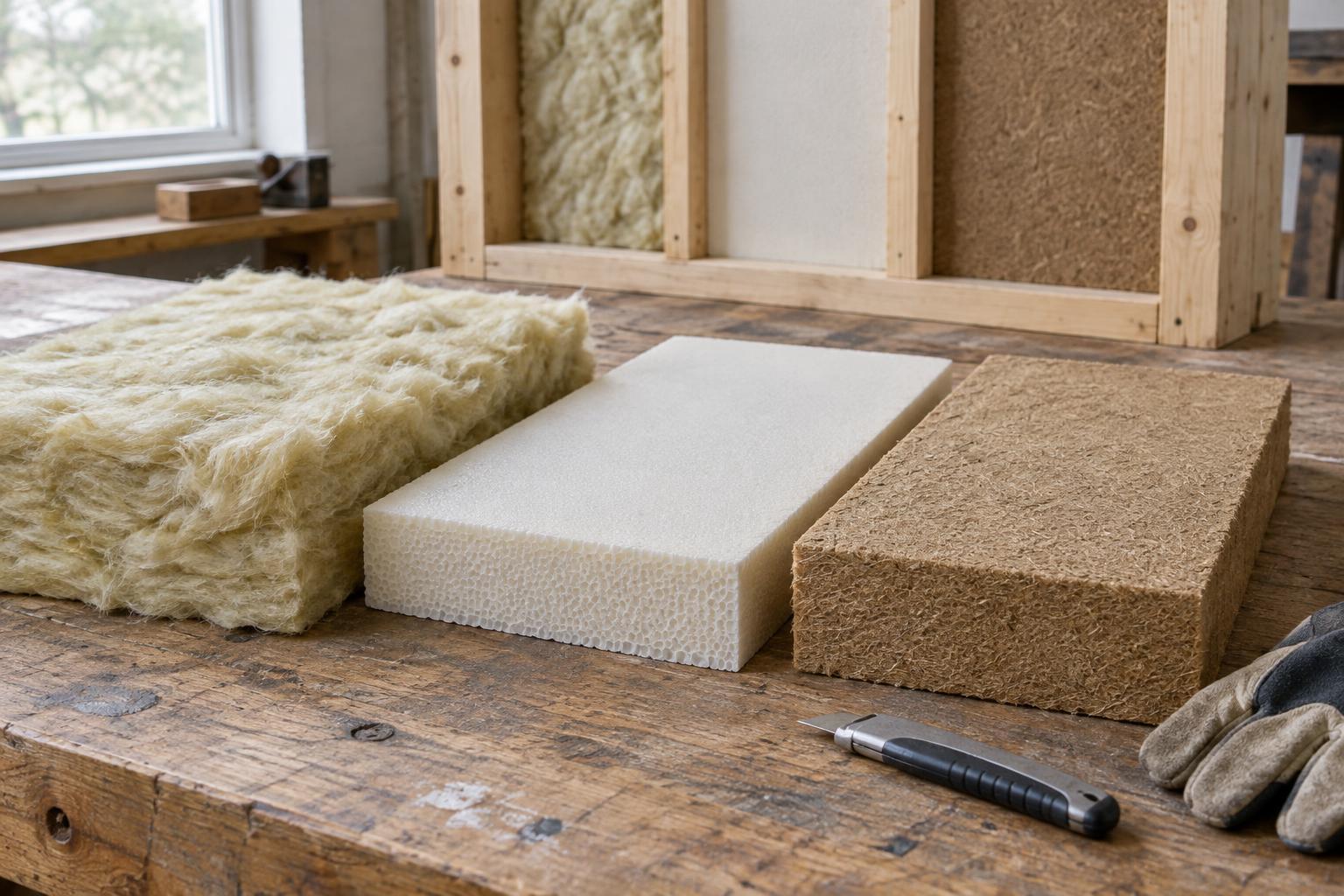
Selection starts with the shape and conditions of the space. Is the cavity open and regular, or crowded with pipes and supports? Will the material face moisture, repeated handling, vibration, or a load from other components? Does it need to be removable for repair? Fibrous batts, sprayed or board foams, and other rigid products answer these questions differently. Rigid foam boards overlap two of those categories, so the labels are a starting point rather than a strict classification.
Fibrous insulation: adaptable, but sensitive to fit
Fibrous insulation includes mineral wool, glass fiber, cellulose, and some plant- or animal-based products. Air is held among the fibers, which lets the material limit heat flow while remaining comparatively easy to cut or place in irregular cavities. Batts and blankets suit repeated spaces; loose-fill products can reach areas where a continuous batt would be difficult to install.
The advantage of flexibility depends on careful placement. A batt squeezed into a cavity, folded around a service, or cut too short may leave a poorly insulated area. Loose-fill materials need the density and containment appropriate to their intended use; settling or displacement can leave voids. Fibrous products also vary in how they absorb, shed, or dry after exposure to moisture, so they should not be treated as interchangeable simply because they look similar.
In a workshop, fibrous insulation can be attractive when cavities have minor dimensional variation or when an assembly may need to be opened later. Cutting methods, dust control, protective equipment, and clean storage matter for comfortable, consistent handling. Product-specific instructions should guide those choices.
Foam insulation: shaped boards and in-place applications
Foam insulation holds gas within a network of cells. It is available as factory-made boards and as materials applied in place, depending on the product. Board foam can provide a predictable thickness over a broad, even surface and can be cut into repeated shapes. In-place foam can follow complex details and may help close small gaps, but the result depends strongly on preparation and application.
Foams differ in cell structure, moisture behavior, strength, and response to heat. A foam board that works well as a protected layer may be unsuitable where it is exposed to impact or high temperatures. Likewise, an in-place foam is not an automatic substitute for deliberate joint design or air sealing throughout an assembly. Edges, penetrations, and transitions still need attention.
For fabrication, consider whether offcuts can be used in smaller parts and whether adhesives or coatings are compatible with the chosen foam. Some foam products require protective coverings in their finished use. Fire-performance requirements and installation conditions vary by application, so the product documentation and applicable requirements should be checked before specifying a foam.
Other rigid options: durability and defined dimensions
Not every rigid insulation product is a foam. Rigid mineral-fiber boards, cellular glass, and wood-fiber boards are examples of materials that can be supplied in defined panel sizes. Their compositions and properties differ substantially: one may be chosen for tolerance of heat, another for moisture resistance, and another for the way it integrates with a particular wall or roof build-up. “Rigid” describes a useful handling characteristic, not a single level of strength or thermal performance.
Panels can simplify measuring, stacking, and repeatable cutting. They can also be awkward around crowded details, where numerous small pieces create more joints and more opportunities for gaps. Weight and edge durability affect transport and installation: a board that is easy to position on a bench may need extra care when carried across a site. Where a panel must support a finish or resist compression, check its stated suitability for that role rather than relying on its firm feel.
Choose for the whole assembly, not just the material
A useful comparison begins with the required thickness, available space, and intended thermal performance, then moves to fit, moisture exposure, fire behavior, and mechanical demands. Consider how adjacent layers manage air and water vapor. An insulation material cannot correct a leak or a drainage problem, and trapping moisture within an assembly may create problems even when the insulation itself remains intact.
Resource use belongs in the same discussion. A material that makes efficient use of space may require more processing; a lower-impact material on paper may create substantial waste if it must be cut into many unusual shapes. Plan panel layouts, specify sizes that suit the design, protect stock from damage, and keep offcuts separate where reuse is practical. Comparing products on the basis of service life, repairability, and the complete assembly is more useful than choosing by material label alone.