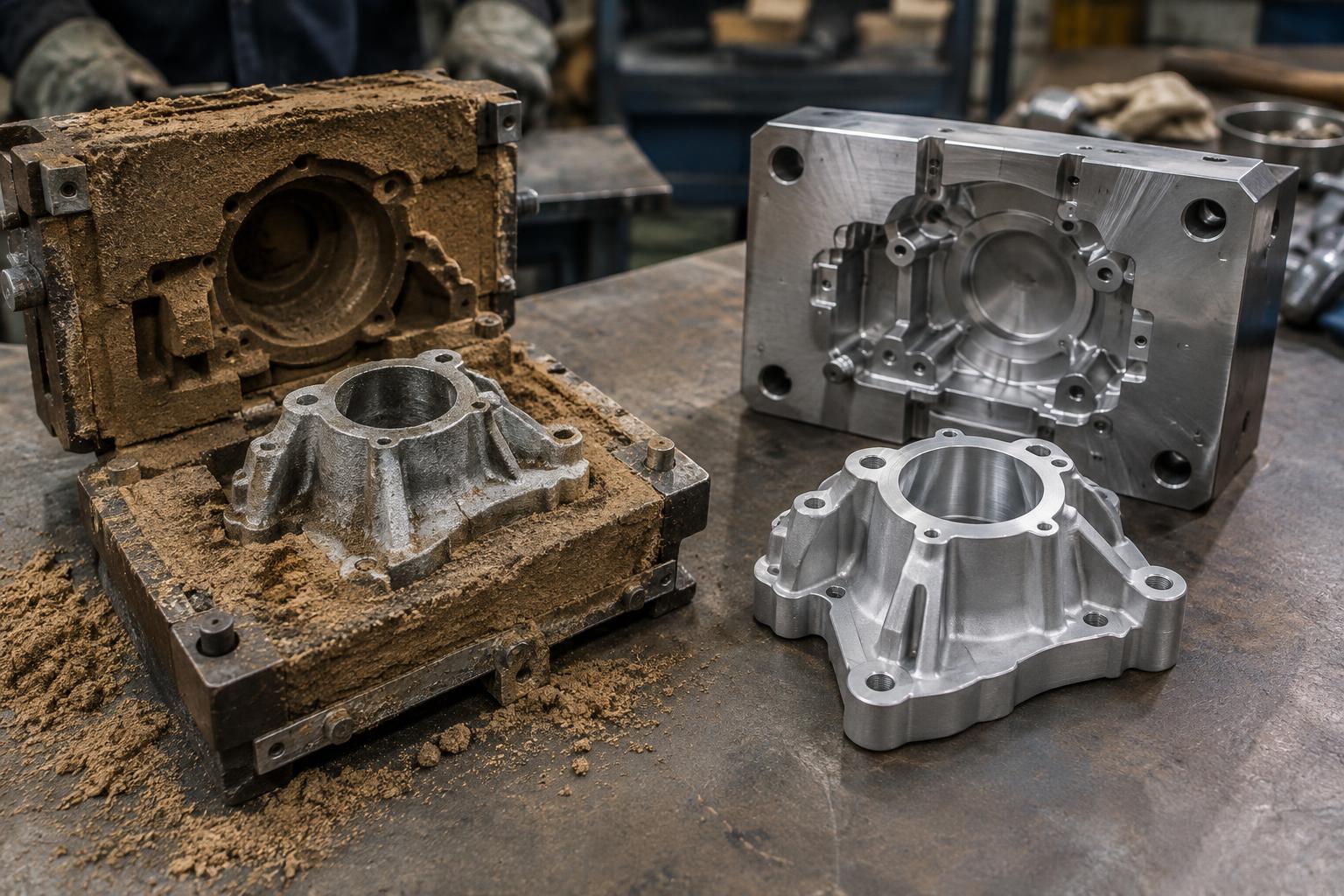
Two molds, two production approaches
Sand casting begins with a mold made from compacted sand around a pattern. Molten metal fills a cavity in the mold and solidifies; the mold is then broken apart to remove the casting. Separate sand cores can form internal passages. Because each mold is used once, the foundry must prepare a new one for every casting, even when the pattern is reused.
In conventional pressure die casting, molten metal is forced into a reusable metal die. The die opens to release the part, then closes for another cycle. This approach is commonly associated with metals such as aluminum and zinc alloys, while sand casting can accommodate a wider range of alloys, including iron and steel when the foundry is equipped for them. Neither process is a universal substitute for the other: the material, shape, required properties, and number of parts all affect the choice.
Tooling cost and the pace of change
A sand-casting pattern and any core-making equipment require planning and expense, but they are generally less costly to make or change than a production die. That makes sand casting useful for prototypes, replacement parts, and designs that may still be revised. It can also suit large parts for which a reusable metal die would be impractical.
A die is a substantial investment. It must withstand repeated cycles while controlling metal flow, cooling, and part release. Once it is ready, however, it can support fast, repeatable production. Changes made after the die is built may be difficult or expensive, particularly if they affect a cavity, a sliding feature, or the way the part separates from the tool.
The comparison is therefore not simply “cheap mold” versus “expensive mold.” A project budget should include pattern or die construction, cores or moving die components, setup, expected tool maintenance, and the cost of making each acceptable part.
Detail, surfaces, and dimensional control
Die casting often produces finer surface detail and more consistent dimensions straight from the tool than conventional sand casting. A smooth die cavity can leave a relatively smooth part surface, and repeated cycles help keep features consistent. Thin walls and small details may be possible, but what is practical depends on the alloy, part geometry, and how well the metal fills the die.
Sand leaves a more textured surface, and mold preparation, cores, and solidification can introduce greater variation. That does not make sand casting unsuitable for precise products. Designers can leave material on critical faces, holes, or mating features so those areas can be machined afterward. Die castings may also need machining where a fit or seal requires tighter control.
Both methods impose design constraints. A part needs a workable parting line and a way to leave its mold or die. Draft angles help with removal, while sharp changes in wall thickness can complicate filling and cooling. Sand cores can create enclosed passages; die-cast features may call for moving tool sections or later operations. Discussing these features before tooling is built is usually easier than correcting them afterward.
Where batch size changes the calculation
For a small run, the lower initial tooling commitment of sand casting may matter more than its slower mold preparation and greater finishing needs. As quantities rise, the cost of a die can be spread across more parts, while short, repeatable cycles become increasingly valuable. There is no fixed batch size at which one process becomes cheaper: part complexity, alloy, labor, machining, scrap, and tool life can move that point substantially.
Forecasts should be treated as forecasts, not guarantees. If demand is uncertain or the design is likely to evolve, a flexible route may reduce the risk of committing to a die too early. If a stable part will be produced repeatedly, investing in die tooling may be easier to justify. Large physical size can still favor sand casting regardless of quantity.
Choosing for the whole part, not just the casting
A useful comparison starts with the finished part. Identify the alloy, overall size, essential internal features, surfaces that will remain visible, and dimensions that must be machined. Then compare sample process plans: how each casting is made, where material is removed, what finishing is needed, and how defects will be checked. Both processes can produce scrap, so the expected yield deserves attention alongside cycle time.
Resource use also extends beyond the mold itself. Sand may be reclaimed and reused where facilities allow, while a durable die serves many cycles but takes considerable resources to produce. Runners, rejected castings, machining allowance, and energy used in melting and finishing all contribute to the overall picture. The sounder choice is the method that reliably delivers the required part with a sensible amount of tooling, processing, and waste across the expected production run.