The difference begins with what heat does
Thermoplastics soften when heated and become firm again as they cool. Within practical limits, that change can be repeated. Polypropylene, polyethylene, ABS and nylon are familiar examples. Their ability to flow when heated makes them suitable for processes such as injection molding, extrusion and some forms of heat welding.
Thermosets behave differently. During curing, their ingredients form a connected structure that does not simply melt back into a moldable liquid. Epoxy and phenolic resins are examples. A cured thermoset may eventually degrade under enough heat, but it will not soften and reform like a thermoplastic. The distinction describes how a material responds to heat, not whether it is strong, durable or suitable for a particular job.
How the distinction shapes production
A thermoplastic part is commonly made by heating material until it flows, shaping it, then cooling it. This can support repeatable production of housings, clips, containers and other parts. The method still has limits: wall thickness, shrinkage, tooling and the particular polymer all influence the finished result. Some thermoplastic products also contain glass fibers, pigments or other additives that change how they process and perform.
Thermoset production includes a curing step, often after a resin has been poured, pressed or applied around reinforcement. That makes thermosets useful for products such as electrical components, adhesives and fiber-reinforced composite parts. Once curing is complete, correcting a shape by reheating is generally not an option. For either family, the material name alone is not a full specification: a part’s formulation and production method matter as much as its broad classification.
Choosing for the conditions of use
Thermoplastics offer a wide range of stiffness, flexibility and impact behavior. A flexible polyethylene container and a rigid ABS housing are both thermoplastics, yet they serve different purposes. Heat is an important consideration because a part can lose its intended shape or strength well before it appears to melt. Fit and load also matter: a snap feature that works at room temperature may behave differently after repeated use or exposure to heat.
Thermosets are often chosen where shape retention, electrical insulation or resistance to particular service conditions is important. That does not make every thermoset suitable for high temperatures or harsh chemicals. Cured materials can crack, chip or age, and their performance depends on their formulation. A practical choice starts with the conditions the part will face, then considers the specific material grade rather than assuming one family is always better.
What can be repaired—and how
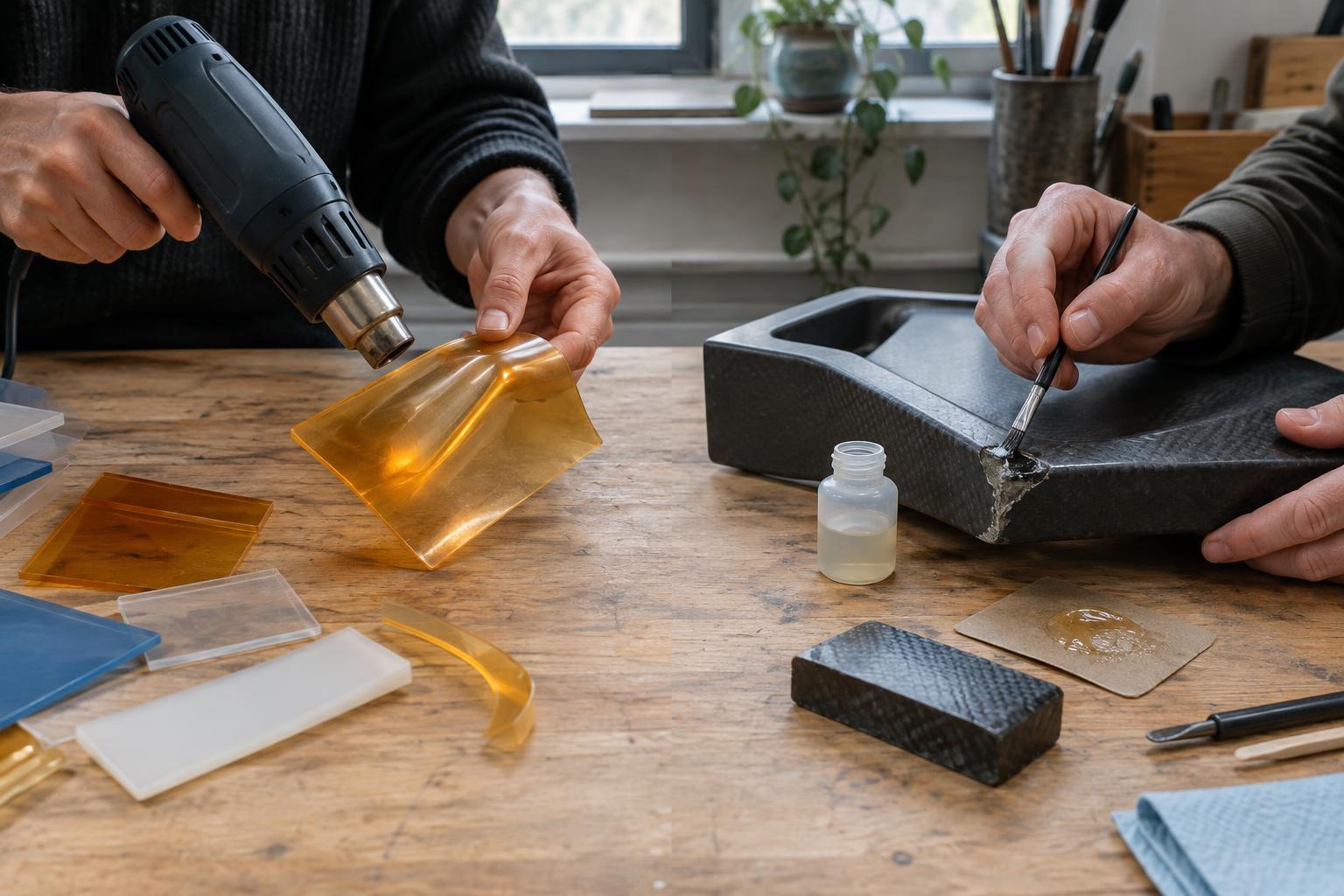
The possibility of reheating a thermoplastic opens repair options, but it does not guarantee an easy fix. Some compatible thermoplastics can be joined by controlled heat welding; others may be better suited to mechanical fastening or an adhesive selected for the plastic. Identification matters. A repair made with an incompatible filler or excessive heat may look sound while leaving a weak joint, distorted fit or damaged surrounding material.
A cured thermoset cannot usually be welded back together by melting its edges. Repairs more often rely on bonding, a reinforcing patch, a mechanical joint or replacement of the damaged piece. A cracked resin-rich composite, for example, may need reinforcement as well as adhesive to restore its intended function. Before repairing either type, consider what caused the failure, whether the part carries a significant load and whether its original function can be reliably checked afterward.
Designing with later care in mind
Material choice affects what happens after a product leaves the workshop. A replaceable thermoplastic cover may be easier to maintain than one permanently bonded into an assembly. Likewise, a thermoset component can have a long useful life when it is protected from the conditions that damage it and can be replaced without discarding the whole product. Access to fasteners, clear material identification and spare-part planning can matter more to repairability than the polymer family alone.
End-of-life handling also needs a case-by-case view. Some thermoplastics can be remelted and processed again, but mixed materials, coatings and contamination can make that difficult. Cured thermosets cannot be remelted in the same way, and bonded or reinforced assemblies may be challenging to separate. Designing to use less material, avoid unnecessary combinations and keep serviceable parts accessible can help conserve resources regardless of which material is chosen.